Hammer to Nail Interview: Crispin Glover – NO! YOU’RE WRONG. or: SPOOKY ACTION AT A DISTANCE

Many actors have added multi-hyphenates to their resumes, dipping into other facets of auteur filmmaking. But no one has done it quite like Crispin Hellion Glover. For that, and many other reasons, he remains one of the most unique artists in the Hollywood sphere. Since the early 1980s, he has logged nearly eighty acting credits, all of them indelible characters in their own right. Mainstream audiences will know him from high-profile studio fare, like Back to the Future, Hot Tub Time Machine, Charlie’s Angels, and as Andy Warhol in Oliver Stone’s The Doors. But it’s in the Indie realm that he truly blossoms. From the Christmas-obsessed, prolific sandwich maker “Jingle Dell” in David Lynch’s Wild at Heart, to an exceptionally burnt-out office worker in Bartleby, to one of cinema’s most disturbing troubled teens in River’s Edge, Crispin Glover is a character actor who is also a character himself. When he’s not producing his own films and books, he continues to turn out top-notch performances in indie films, such as the existentially tormented titular character in the upcoming labyrinthian surreal drama, Mr. K.

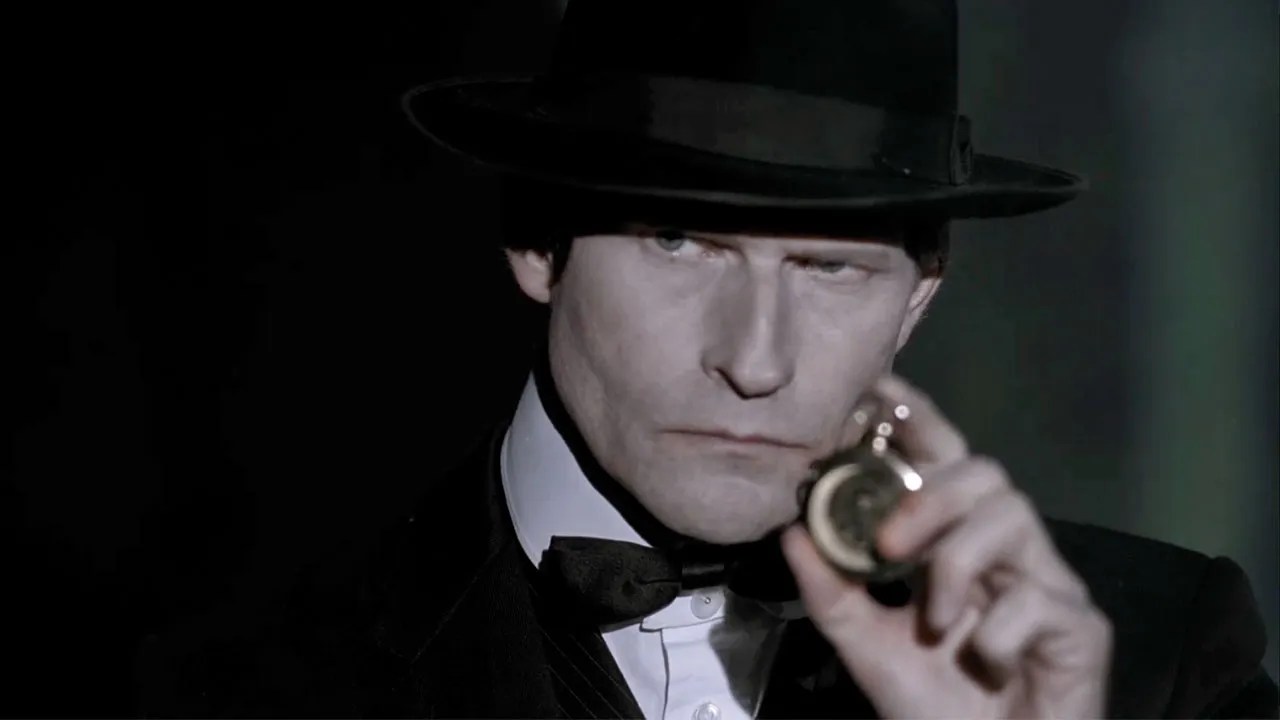
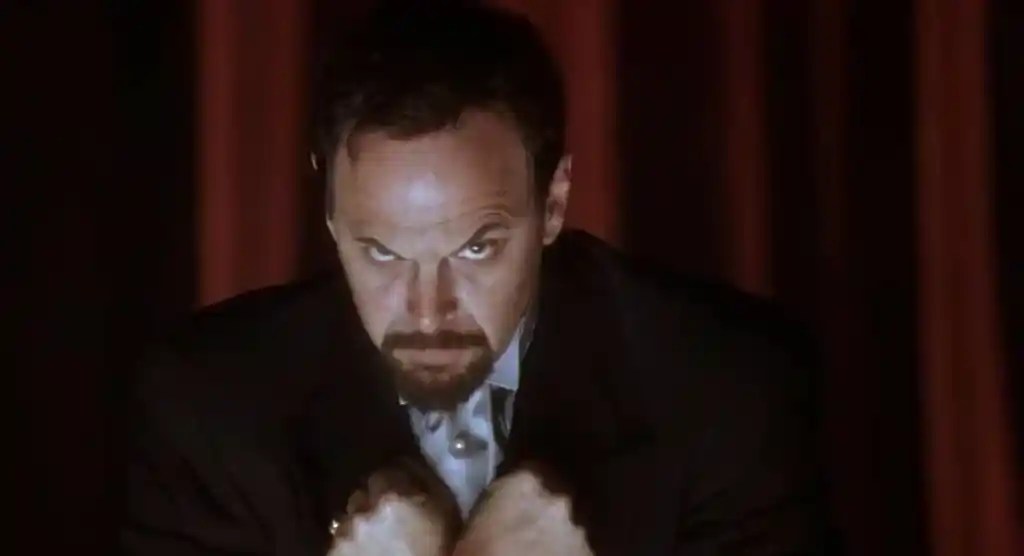
At the moment, Glover is full steam ahead on No! YOU’RE WRONG or: Spooky Action at a Distance, a film he spent a decade writing, shooting, and editing himself. Glover wrote it, in part, with his now-late father, Bruce Glover (Diamonds are Forever, Chinatown), and they both perform in it as multiple characters at different ages and eras. If you’re familiar with Glover’s previous Volcanic Eruptions releases (Parts one and two of the It” Trilogy), you’ll be (somewhat) prepared for No! YOU’RE WRONG.

Glover has always shunned the traditional distribution routes, instead opting for the hands-on approach of touring his films around the world within the framework of something he calls “The Big Slide Show”. The program begins with a stylized audio-visual reading from his books (i.e. the slide show), followed by a presentation of his latest film, and a Q & A with the audience. You will never see these films without Glover’s involvement, making the experience not only unique, but also elusive. This is why I had to conduct the following interview, having only seen a trailer for No! YOU’RE WRONG. or: Spooky Action at a Distance. But, having previously experienced What is it? and It is Fine! EVERYTHING IS FINE! by way of The Big Slide Show, I can assure you that if he does come your way, you should do everything in your power to attend. No matter how you feel about the film itself, you’re guaranteed a transformative and unforgettable cinematic experience.

The day after the world premiere of No! YOU’RE WRONG, I spoke with Glover about the why he likes people-watching during screenings, working with David Lynch, the beauty of Formalist production design, why he doesn’t like to give concrete answers about his work, and how he was surprised to learn – after the fact – that David Lynch executive produced his first film. This interview has been edited for economy and clarity.

Hammer to Nail: It’s lovely to speak to you. I don’t expect you to remember this, but I did meet you twice before: once in 2006 at Sundance…

Crispin Hellion Glover: It was probably 2005, 2006, or 2007. I was there in 2005 with What is it? and again in 2007 with It is Fine! EVERYTHING IS FINE. I think I went in 2006 for something. Not for an official film release. Maybe some follow-up media stuff.

HtN: Yeah, I don’t think I saw your film there, but I have seen “The Big Slide Show” since.

CHG: Good. Were you able to see the film last night? [It premiered at New York City’s Museum of Modern Art on October 2nd, 2025].

HtN: No. I’m in Seattle. I’ve only seen the trailer and read the credit scrawl provided by P.R. But I’m gonna do my best to ask about it. I know you had your premiere last night so I’m dying to know how it went because it was your first time showing it to an audience.

CHG: It was a very nice reception. I’m very glad to have premiered it at MoMa. It was interesting for me because I’ve shown it to individuals before, but I’ve never shown it to an audience before and there are different things that an audience will react to as a whole [rather] than individuals. And there is some humor to it. Which… I can’t tell what reads as humor even to people I’ve shown it to as individuals. But when you get hundreds of people together, laughter and that kind of thing become more apparent. So, you’ve seen one or two of the other films [I directed]?

HtN: Yes, I’ve seen What is it? and It is Fine!

CHG: Oh, great! Very good. So those films have humor within them… and it’s pretty dark humor, for the most part… There are things with What is it? that the audience will laugh at sometimes – or certain people in the audience – that are not necessarily things that I think of as being funny. And it isn’t like they’re being mean or anything like that. It’s interesting to me. Sometimes they’ll laugh at things I think are funny. But sometimes not. And then there are things that I think are very funny that nobody laughs at…

[Both laugh]

CHC: What makes me laugh is that I know the audience is in a sort of an internal turmoil of how to react to certain things… But the new film isn’t operating that way. It’s a different kind of humor. And I was actually surprised at how much there was. Because I thought it was the kind of thing people would maybe internalize and have an internal [reaction like], “this is amusing”. But there was actually out-and-out laughing in places that I have thought of as being humorous. But I [didn’t expect] as much outward audible laugher [as there was]. Now, it could have been a super enthusiastic audience, being premiere night at MoMa. Maybe I won’t have that as much [at future screenings]. But it was nice to hear. And then I genuinely was interested to hear how people reacted to the film because it was my first audience. And it was very astute. I was surprised at how much people picked up on. Many of the people I [had previously shown it to] are filmmaker types, who have a certain kind of… I suppose, sophistication within cinematic… what-have-you. And I don’t know, maybe 90% of the people that came last night were filmmaker types. [I knew] some of the people who were there. But it was a very nice response. I was very pleased…

Read the rest on Hammer to Nail!

Hammer to Nail Interview: Megan Griffiths & Eliza Flug (YEAR OF THE FOX)

Megan Griffiths’ latest film, Year of the Fox, is a coming-of-age drama that takes place in 1997 Aspen and Seattle. Ivy (Sarah Jeffery) is a young woman on cusp of finishing high school, when she gets a disillusioning peek behind the curtain of her parents’ social circle. There she finds selfishness, deceit, pettiness, judgement, and a ring of untouchable predators. If you are reading this in America in the year 2025, this dynamic may sound achingly familiar. Systematic patriarchal exploitation is as American as apple pie.

As you may have guessed, screenwriter Eliza Flug’s semi-autobiographical tale leans dark. But it’s not a suffocating darkness. As Ivy puts it: “It’s hard to trust the good memories through the bad, but they were just as real”. Griffiths has always been deft at maintaining this verité tonal balance, ever since her quiet stunner, The Off Hours, premiered at Sundance in 2011. Griffiths and Flug are a match made in feminist cinema heaven. Their affinity for a light touch is a breath of fresh air in this perpetual landscape of male-dominated cinema. Sometimes the occasion calls for a Coralie Fargeat protagonist barfing up blood all over the patriarchy, and other times, a cozy, quietly scathing tone poem like Year of the Fox delivers a similar catharsis. Together, this dream team has crafted a formidable film about the ripples created when powerful men use their influence to hurt women – without repercussion – time and time again.

I recently chatted with Megan and Eliza about their journey since the film’s debut at the Seattle International Film Festival, trusting the audience to grasp narrative nuance, the music and films that inspire them, and using art as an act of rebellion.

 This interview has been edited for clarity and brevity.

Hammer to Nail: Thank you for joining me today and for making this incredible film. I felt a personal connection to Year of the Fox because I graduated from high school in 1996 and moved to Seattle for college. The dynamic between Ivy’s parents is very familiar to me. I found myself gasping in recognition, especially when the parents talk to each other because that’s how my parents talked to each other for many years.

Megan Griffiths: Glad it was relatable.

Eliza Flug: Sorry it was relatable.

[Everyone laughs]

HtN: And I also loved that you showed something rarely depicted in movies and TV, which is that an encounter with a predator can be just as traumatizing even if they don’t get what they came for. Just being in proximity to the danger. Seeing that play out on screen was so unusual.

MG: Yes, a near miss can be traumatizing too.

HtN: The film premiered at the Seattle International Film Festival in 2023. What was the journey like from the festival debut to the recent release?

MG: We were working with a distributor and ultimately, they weren’t putting out the film, and so we ended that relationship and worked with our new distributor, Monument Releasing, to get the film [out]. We’ve been waiting anxiously to release the film for this entire period so we’re happy to be getting it out now.

HtN: When did you start production?

MG: We shot it in 2021.

HtN: Wow!

MG: Yeah, it’s been a long journey. It’s not like the COVID era is ancient history but it is weird to think about the fact that we were shooting with a very freshly vaccinated crew with very strong limits on how many people could be in our party scenes and how to get people to be on set together safely. This was all very present in our production.

EF: And on the production side, it was a 15% markup for a COVID nurse to be on set at all times, and on the insurance cost. On my end, it was interesting to see that happen. There had been shutdowns in L.A. In the month while we were filming in Colorado and Washington state, we’d had one within less than two months. So, getting together as a community was special. It was actually really nice to see humans and be together. It was a really special time, for sure.

MG: Yeah, and it was a story we were both really ready and excited to share, and it’s just been a challenge. I mean, the entire film landscape is a challenge right now, so we’ve just been part of that – the issues that are affecting every filmmaker these days.

HtN: Yeah. And issues that are affecting every woman. I mean, you shot this so long ago and it was as true in 1997 as it is today in 2025. So many truths in this movie.

You both complimented each other creatively on this film. Eliza, in your writer’s statement for the film you talked about how power is always better when it is shared. [Author’s note: The full quote is, “It was freeing to write this reflection and to see Megan Griffiths, a filmmaker I respect, take what she read and create this translation, to work with her and to learn about power, and how it is better when it is shared. Always.”]

How did you share the power when you were collaborating on this film?

EF: I think that you choose it, and you’re very selective on how you do something, especially if you want it to be relatable to other people. You have to be true, and you hope for that truth and integrity in the relationship. It’s not something you can force. And it’s something you come by honestly every day. And so, Megan led the charge on that with production and with her community – our shared community of women working together, wanting to create something that would speak to our children. It was more about, “what do they think of this and what will they see?” Making film can be very selfish and making art is very self-involved, but it was an act of trying to create something for other people as opposed to just being about the past or the self. I think we both came from that perspective, which made it easy to work together.

MG: I think we had a shared desire to have this conversation be – not just something that was happening between the two of us over coffee – but having with an audience. Within our culture the conversation’s gotten a lot louder recently because of what’s leading the headlines these days, but it’s not new. The idea of talking about sexual politics, talking about predation, both sides of the coin – the people who are predators and the people who are interacting with them and having their lives impacted by them – these are all conversations that have been going on since way before this movie, since way before Jeffrey Epstein, but they’re coming to a head culturally right now and I’m glad we’re able to contribute our little piece of the puzzle…

Read the rest on Hammer to Nail!

Hammer to Nail Interview: Richard Green, director of I Know Catherine, The Log Lady

Twenty-five years after the season two finale of the seminal prestige drama Twin Peaks aired, David Lynch heralded a third season with the following tweet: “That gum you like is going to come back in style.” This was exciting news for Twin Peaks fans and David’s frequent players alike. Catherine Coulson started working with David in his Eraserhead days, which was also when the two friends first conceived the mysterious, enigmatic, and prescient character, The Log Lady, who would eventually serve as a sort of Greek Chorus for the show and an oracle for the characters. There was no way Coulson was going to let a little thing like a terminal cancer diagnosis stop her from participating in Twin Peaks: The Return.

Director Richard Green (7 Year Zig Zag) saw a cosmic opportunity to bookend I Don’t Know Jack (his 2002 documentary about Catherine’s first husband, Jack Nance) with a peek into Catherine’s prolific legacy both in art and interpersonal connection. I Know Catherine, the Log Lady is a captivating, poignant depiction of this indelible renaissance woman who was so much more than just “the lady with the log”. Jessica Baxter recently got a chance to speak with Green about his process, inspiration, working with David Lynch, and the incomparable experience of seeing film in a movie theater.

This interview has been edited for clarity and brevity.

Hammer to Nail: Thank you so much for meeting me today. I loved your movie. It was just such a moving depiction. I already knew a little bit from just reading about Catherine and then of course seeing The Return. But there was so much I didn’t know so thank you for filling in all those blanks.

Richard Green: It’s a pleasure to have you watch it and I appreciate what you’re saying, thank you.

HtN: So, you met Catherine in the early 70s in San Francisco?

RG: Actually, I never met her in San Francisco. She had been in San Francisco and then she moved down to L.A. and went to [The American Film Institute]. And I moved up to San Francisco right about the same time and started a theater company… All of the people that had been in hers – the Circus – migrated into ours – the Theater of Marvels. I met Jack [Nance] up there but I didn’t meet Catherine until I came down [to Los Angeles]. It was ‘73, I was 20. I was on my way to hitchhike around Europe for a year, to do the hippie adventure [laughs]. And I ended up auditioning for something that one of Catherine’s close friends was in and staying in L.A. for an extra 12 weeks. And, in that time, the place I hung out was in Beachwood Canyon with Catherine, and Jack at their apartment where David [Lynch] was also living at the time. And it was just fun. It was a great place to hang out. Jack was hysterical. David was charming. And Catherine would constantly make sure you had enough to eat and drink… Heaven.

HtN: That sounds divine. Do you remember your first interaction with her or an early memory of meeting Catherine?

RG: You know, I do but it’s very vague… but it is coming up the stairs…I know exactly the stairs, just going into the apartment [in Beachwood Canyon] which my friend lives in now. And I just remember Jack and David at a table, and Catherine coming out of their kitchen The stove and the sink are right there by the door, and she would pop her head out: [musically] “Can I get you anything?” …Kind of this singing… Half of it’s probably fantasy but I just remember her as, everything being musical. The way she moved and the way she talked and the way she laughed had kind of a musical rhythm to it. It was different than anybody that I knew. That’s what I remember about Catherine and then, ya know, just her and Jack kinda… [pantomimes two fists banging together]…

Read the rest on Hammer to Nail!