

Hammer to Nail Review: Again Again

Again Again is an official selection of the 2026 Seattle International Film Festival!

For their feature debut, co-directors Heather Ballish and Mia Moore Marchant unquestionably drew inspiration from the time loop film that defined the genre, but Again Again completely upends the premise of Groundhog Day by daring to ask the heady philosophical questions. What if the person stuck in the time loop is not a selfish, curmudgeonly, white cis man who needs to learn to love someone other than himself, but a young trans woman who can’t love herself? Moreover, what if after the loop breaks, she doesn’t just get the girl and live happily ever after? Instead, their relationship picks up in the messy place where it left off pre-loop; only now one half of the couple has acquired a decade’s worth of baggage that the other half blissfully forgets with the dawn of each new day. What this fantastic genre bender presupposes is, maybe the looper would have intense PTDS from this experience, that would only be catastrophically exacerbated by the sudden and unexplained end to the phenomenon.

We first meet Agatha (Marchant) on her 2863rd go-round of a day that follows a traumatic event. She spends a lot of time in bed in a yin-yang configuration with her unaffected girlfriend, Tessa (Aria Taylor, Charlie Says). Aggie is painfully aware of how long she’s been stuck because every day she writes the new number on her hand in permanent marker. This is a brilliant story device (not to mention a powerful repeated image) because it helps orient the audience as Aggie’s story unfolds through flashbacks. In fact, Marchant’s entire script is exemplary at metering out exposition. It’s not just what you learn, or how you learn it, but also when you learn it. As we jump through time with Aggie, we learn details of her and Tessa’s history at the most emotionally impactful moments. I don’t know how many drafts there were of this script, but it feels controlled and fine-tuned in a way that is very rare for debut films.

I’ll try to keep plot details to a minimum because everyone should be able to experience the thrill of discovery that Marchant’s script provides. But what we know pretty much right away is that these two young women were childhood best friends since before Aggie’s transition, and now they’re in love. But Tessa, who is cis, is also engaged to a cis man. Most of the film takes place in a tastefully and lovingly adorned camper van where the two women have circular conversation about their past, present and future. Most of these conversations have already taken place many times, but Tessa can’t remember. On day 2864, Aggie wakes up, looks at her hand baring the number of the day before, and realizes she’s free. But her freedom from the loop creates a whole new prison of uncertainty, as Aggie and Tessa attempt to figure out what this means for their future.

Again Again was filmed in and around Aberdeen, WA where Marchant grew up. Aberdeen is best known as Kurt Cobain’s hometown. Much of Kurt’s work was informed by the experience of growing up a sensitive, nonconforming artist in this backwards industrial burgh. The song title “Come as You Are” is a reference to the ironic “motto” emblazoned (to this day) on the sign that welcomes you into town. “Something in the Way” is about the deep despair that Kurt felt when he hid under the Young Street Bridge, which overlooks the “Muddy Banks of the Wishkah” (also the name of a live Nirvana album). A pivotal scene in Again Again takes place under Kurt’s bridge, which has since become a shrine emblazoned with fan-scrawled messages and even a plaque. Marchant’s deft utilization of this location is subtle. No character calls out its historical significance. But if you know, you know, you know?

Marchant’s Aberdeen is also sometimes quaint and inviting, such as when she visits Boom Town Records and flirts with the trans woman (Abigail Thorne, HBOs House of the Dragon), who works there. And because it’s the Pacific Northwest after all, the scenery is sometimes arrestingly beautiful, such as when Aggie kicks along the beach in her combat boots and flannel in the cloudy, cool morning. This town, like it’s inhabitants, contain multitudes.
Read the rest of this review on Hammer to Nail!

Film Review: Minor Premise

Minor Premise was shot pre-pandemic, but the panic, paranoia, and desperate isolation Eric Shultz’s debut delivers will doubtless resonate with occupants of this modern world. We may as well get used to scripts like this. With only 3 characters, and one primary location, the film still manages to build a riveting narrative off of an extrapolated premise. The protagonist is Ethan (Sathya Sridharan, Bikini Moon), a neuroscientist who is falling apart under personal and professional pressures. With a looming deadline, he decides to fast track his current project by experimenting on himself. Obviously, this tinkering has some pretty dire consequences.

The narrative joins Ethan in the middle of his crisis. He ran a program on his own brain and now he repeatedly blacks out and loses time. He misses an important meeting, prompting Allie – his former flame and current colleague – to check on him. Allie (Paton Ashbrook, TV’s House of Cards) catches Ethan at a bad time and he locks her in a room. When he neutralizes, he and Allie quickly manage to work out what’s going on in the old noggin.

Ethan was attempting to carry on his recently deceased father’s work – a machine that isolates and records memories. The ultimate goal is to curate thought in order to treat people with PTSD or addiction. Ethan figured out that memory is tied to emotion and, as such, accidentally split his own psyche into 10 parts, or traits. Each trait gets to party in full control of his body for 6 minutes per hour. This in-and-of-itself isn’t great, but this constant switching also fries significant amounts of brain cells during every transition. There’s a limit to how much he can take. He needs to merge is brain back and fast. He’s got two useful selves: intellect, and a sort of baseline personality that is his unified brain. The other parts are more id-driven traits such as anger, libido, anxiety, and euphoria, during which time he’s not particularly productive. This gives Ethan and Allie essentially 12 minutes per hour to figure out how to fix Ethan before he becomes a vegetable.

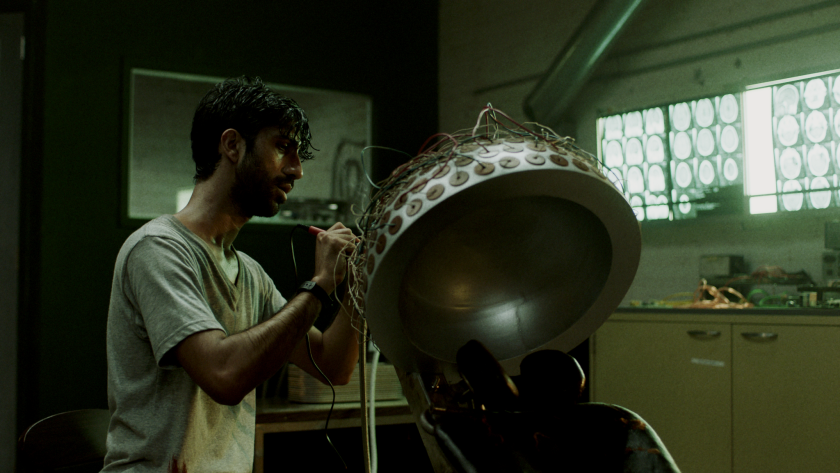
It’s not often that a visibly low-budget sci-fi film still works as a successful genre picture, but the script co-written by Schultz, and producers Thomas Torrey and Justin Moretto, is tight, cerebral, and rooted in real science. The three writers all have degrees to back up the neuro-babble. Ethan is a rogue academic so it stands to reason that he would have to work on a fixed budget out of his basement. It doesn’t even seem that incredible that he might fashion a neuron-altering machine out of an old salon hairdryer chair. Schultz utilizes the most basic filming and editing tricks, such as slow motion, jump cuts, erratic camera movements, and soft focus to effectively convey Ethan’s unstable mental state. A wall clock and a watch timer help temporally orient the viewer. Security camera footage fills in gaps inside and out of the narrative. Schultz and team were clearly influenced by thinky sci-fi the likes of Primer and Pi, with a little Eternal Sunshine brain-mapping for dramatic tension.

Of course, the plausibility of this premise relies heavily on performance. Sridharan must convey 10 distinct selves, all whilst still being essentially himself and he must do it with very few props or scene partners. Much of the film consists of close-ups of Ethan’s sweaty face so it’s a damn good thing Sridharan has the range to pull this off. It’s an extremely impressive performance from a man who must wake up confused about 1000 times and instantaneously inhabit a different concentrated part of his personality. Sridharan is mesmerizing and honestly, without this caliber of talent, the film wouldn’t have held together nearly this well. They mostly brush past his base personalities but we do get a much-needed musical interlude/dance break. Allie and Ethan get a brief chance to reconnect on an emotional level during another visit from Euphoria.

With Sridharan happily chewing the meaty bits of the script, that unfortunately leaves Ashbrook with the gristle. Allie is unquestionably supportive of Ethan, despite her “ex” status. They don’t go into what ended their relationship, but the implication is that Ethan was the one who drove her away with his consuming drive. You wouldn’t know there were any hard feelings based on her head-first dive into this risky plan to save Ethan. It’s not just risky for him. He also has an angry side that physically assaults Allie, and a sinister mysterious side that seems to be actively attempting to sabotage their mission.

Allie does have one other dimension which is that of the curious mind. She cares about Ethan and wants to save him, but she is also invested in the science itself, which allows for some natural expository dialogue about what they’re working on from scene to scene. The third player in the story is Malcolm, the head of the department who is lighting a fire under Ethan’s ass for results goddamnit. When Malcolm (played by Paton’s uncle and Twin Peaks alum, Dana Ashbrook) shows up unexpectedly at Ethan’s place, he’s greeted by one of the more violent personalities and they have to add keeping him unconscious and wiping his memory to their already monumental to-do list.

With Minor Premise, Schultz has cemented himself as a sci-fi director to watch. I can only hope he doesn’t let a budget destroy his creativity.