Again Again is an official selection of the 2026 Seattle International Film Festival!
For their feature debut, co-directors Heather Ballish and Mia Moore Marchant unquestionably drew inspiration from the time loop film that defined the genre, but Again Again completely upends the premise of Groundhog Day by daring to ask the heady philosophical questions. What if the person stuck in the time loop is not a selfish, curmudgeonly, white cis man who needs to learn to love someone other than himself, but a young trans woman who can’t love herself? Moreover, what if after the loop breaks, she doesn’t just get the girl and live happily ever after? Instead, their relationship picks up in the messy place where it left off pre-loop; only now one half of the couple has acquired a decade’s worth of baggage that the other half blissfully forgets with the dawn of each new day. What this fantastic genre bender presupposes is, maybe the looper would have intense PTDS from this experience, that would only be catastrophically exacerbated by the sudden and unexplained end to the phenomenon.
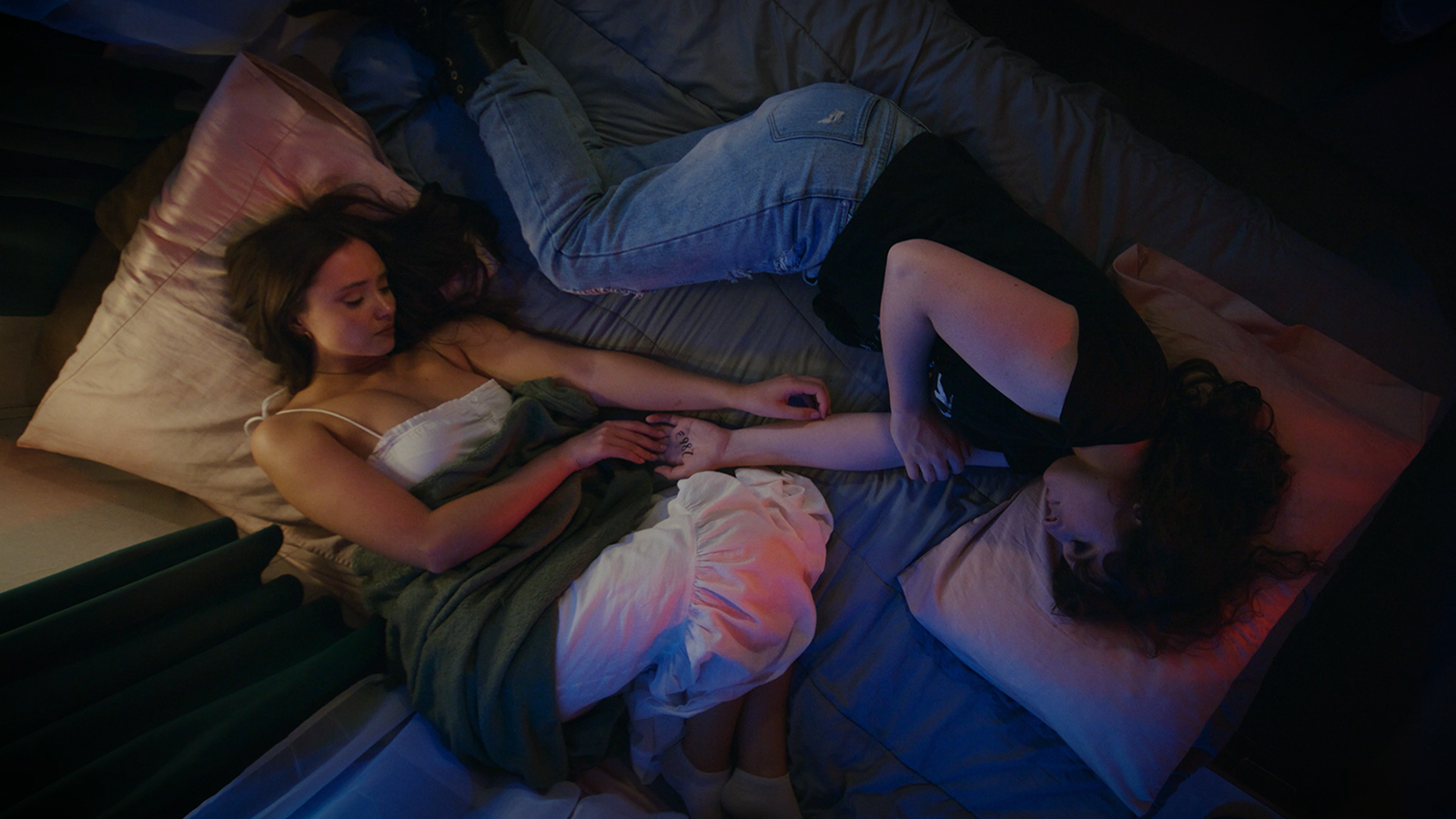
We first meet Agatha (Marchant) on her 2863rd go-round of a day that follows a traumatic event. She spends a lot of time in bed in a yin-yang configuration with her unaffected girlfriend, Tessa (Aria Taylor, Charlie Says). Aggie is painfully aware of how long she’s been stuck because every day she writes the new number on her hand in permanent marker. This is a brilliant story device (not to mention a powerful repeated image) because it helps orient the audience as Aggie’s story unfolds through flashbacks. In fact, Marchant’s entire script is exemplary at metering out exposition. It’s not just what you learn, or how you learn it, but also when you learn it. As we jump through time with Aggie, we learn details of her and Tessa’s history at the most emotionally impactful moments. I don’t know how many drafts there were of this script, but it feels controlled and fine-tuned in a way that is very rare for debut films.
I’ll try to keep plot details to a minimum because everyone should be able to experience the thrill of discovery that Marchant’s script provides. But what we know pretty much right away is that these two young women were childhood best friends since before Aggie’s transition, and now they’re in love. But Tessa, who is cis, is also engaged to a cis man. Most of the film takes place in a tastefully and lovingly adorned camper van where the two women have circular conversation about their past, present and future. Most of these conversations have already taken place many times, but Tessa can’t remember. On day 2864, Aggie wakes up, looks at her hand baring the number of the day before, and realizes she’s free. But her freedom from the loop creates a whole new prison of uncertainty, as Aggie and Tessa attempt to figure out what this means for their future.
Again Again was filmed in and around Aberdeen, WA where Marchant grew up. Aberdeen is best known as Kurt Cobain’s hometown. Much of Kurt’s work was informed by the experience of growing up a sensitive, nonconforming artist in this backwards industrial burgh. The song title “Come as You Are” is a reference to the ironic “motto” emblazoned (to this day) on the sign that welcomes you into town. “Something in the Way” is about the deep despair that Kurt felt when he hid under the Young Street Bridge, which overlooks the “Muddy Banks of the Wishkah” (also the name of a live Nirvana album). A pivotal scene in Again Again takes place under Kurt’s bridge, which has since become a shrine emblazoned with fan-scrawled messages and even a plaque. Marchant’s deft utilization of this location is subtle. No character calls out its historical significance. But if you know, you know, you know?
Marchant’s Aberdeen is also sometimes quaint and inviting, such as when she visits Boom Town Records and flirts with the trans woman (Abigail Thorne, HBOs House of the Dragon), who works there. And because it’s the Pacific Northwest after all, the scenery is sometimes arrestingly beautiful, such as when Aggie kicks along the beach in her combat boots and flannel in the cloudy, cool morning. This town, like it’s inhabitants, contain multitudes.
 Effed by the Wind