SIFF REVIEW: THE WALL

2013 SEATTLE INTERNATIONAL FILM FESTIVAL SELECTION!
Unrated
108 minutes 

**

An apocalypse movie comes in many forms. Some are of the action-packed, Will Smith variety, and some are quiet intellectual horror films like Julian Roman Pölsler’s film “The Wall.” Though I do consider the latter style superior to the former – seeing a real person experience apocalyptic solitude is so much more interesting than when it happens to a borderline superhero – I would rate “The Wall” and “I Am Legend” about the same. This is due entirely to Pölsler’s excessive use of voiceover.

Pölsler adapted “The Wall” from the 1962 identically titled book by Marlen Haushofer. While it may be necessary in a novel to have your character narrate every second of the story it is not the case with a movie. It’s not that Pölsler should have eliminated Haushofer’s words altogether. Some of her sentiments are florid and insightful. But he should have kept it to abstract thoughts not evident from the action or lead actress Martina Gedeck’s (“The Lives of Others”) incredibly effective performance. That would have been a 4 or 5 star film.

The story concerns a nameless woman on vacation in an Alpine hunting lodge who awakens one morning to find her companions not yet returned from their previous day’s excursion into town. When she, along with her friend’s dog Lynx, goes looking for them, she discovers that she is trapped behind a vast transparent barrier. The woman makes a cursory attempt to figure out what’s going on, but gives up once she spots some neighbors on the other side of the wall seemingly frozen in time. Whatever has happened out there, she assumes, has left no survivors. So rather than to try and find a way around the wall or search for another person on her side, she accepts what she believes is her fate and sets about living off the land.

An urban gal, it takes her some time to find her agricultural groove. But she is fortunate enough to find a pregnant cow, stocked pantry, and basic farming and hunting gear. Eventually, the woman settles in to her approximation of civilization along with Lynx (now utterly devoted to her), the expecting cow, and a couple of cats. She insists on keeping track of the days, despite noting that it no longer means all that much. We know from the narration, which comes from a “report” she is writing several years into the future, that Lynx eventually succumbs to a horrific end. But that information is just one example of many such unnecessary or redundant passages blanketing the film from start to finish.

I find it incredibly frustrating when I see a film that is so close to touching greatness but for one or two egregious errors. The voiceover does such a disservice that I’m tempted to recommend watching the film on mute. Pölsler should have had more faith in Gedeck and his own ability to tell a visual story. The type of audience who would be interested in seeing “The Wall” is not stupid. They can tell from the woman’s changing face that the story flashes forward and backward in the timeline. The woman from the beginning of the story is frail and fair skinned, wrestling with the morality of the food chain. The woman from the voiceover is the one with the short hair, confident gait, utilitarian wardrobe and steely expression. They don’t need her to tell them when she is having an emotional breakdown because they can see it in her body language and the tears streaming down her face. They certainly don’t need her pointing out when the stars are out or a hawk circles above her. For someone leading such a solitary life, she sure does go on.

The voiceover isn’t completely unwelcome. Some of her philosophical musings are intriguingly insightful. Toward the end of the film, one passage in particular seems to suggest that she finally knows where she stands.

“I pity animals and I pity people, because they are thrown into this life without being consulted. Maybe people are more deserving of pity, because they have just enough intelligence to resist the natural course of things.”

Lines like that are likely what inspired Pölsler to make the film in the first place. That she’s keeping a record at all does serve as a bit of unspoken characterization. This is a woman who claims to have lost all hope, yet addresses a reader other than herself. She is a poet and philosopher who wants to remain connected to her humanity through her self-aware accounts. She occasionally theorizes about what may have happened beyond the confines of her pastoral prison, convincing herself that it’s as simple as everyone being dead, despite having seen evidence of something more puzzling. To follow the wall would require more courage and survival skills than staying put in an attempt to keep things as normal as possible until things resolve themselves one way or another.

Of course, there’s always another solution. She admits that she considered suicide but for the animals. She writes about being humble, but it takes a tremendous ego to think these creatures couldn’t survive without her. They are more equipped to deal with a back-to-nature scenario than she is. Sure, dogs love people, but it may have a lot to do with how much people love dogs.

With a cerebral premise, stunning cinematography, a punch-in-the-gut performance from the Gedeck, and some of the most suspenseful miming ever put to celluloid, “The Wall” has such tremendous potential. I hope Pölsler comes to realize that less is more and gets it right next time.

Originally published on FilmThreat.com (now defunct).
SIFF REVIEW: IL VOLTO DI UN’ALTRA (ANOTHER WOMAN’S FACE)

2013 SEATTLE INTERNATIONAL FILM FESTIVAL SELECTION!
Unrated
84 minutes

**

My experience with Italian cinema is mostly limited to the U.S. crossover titles of Fellini, Argento, Bertolucci, and Benigni. But among those examples is one unifying tone: high camp. As far as I know, Italians are cinematically incapable of a light touch. Even in a film about the holocaust things tend to get pretty bonkers.

Director Pappi Corsicato brings not only the Italian flare for camp to his film “Il Volto di Un’altra (Another Woman’s Face),” but also a hint of heavy-handed allegory. There’s not a sympathetic character in the bunch. Also, I’m pretty sure the entire script is built around the idea of spraying a dazzling white room, filled with alabaster-garbed narcissists, in liquid shit.

The story, by Corsicato and Daniele Orland, concerns a famous television couple who share the limelight on a plastic surgery makeover show: Bella (Laura Chiatti) is the hostess and René (Alessandro Preziosi) is the doctor who performs the surgeries out of his remotely located clinic, where his patients wander around the grounds, mummified and bruised from their alterations. The appearance of the residents is just one of the many heavy-handed examples of the film’s thesis surrounding superficiality.

One day, the show’s producers give Bella the ax because the show’s numbers suggest that the country is ”tired of her face.” René does nothing to help her, and she storms out, only to have a fateful encounter with the wrong end of a toilet (although I suppose there is no “right” end).

Tru Tru (Lino Guanciale), a grimily handsome maintenance worker at the clinic, is the man responsible for dropping the wayward toilet through Bella’s windshield and directly onto her face (where the bowl creates a perfect, blood-filled frame around her – I’ll let you work out the physics on that one). At first, he’s guilt-stricken about the accident and “rescues” her from the wreck. But then he overhears René and an unharmed Bella formulate a plot to collect a big insurance payoff and re-boot her career with televised facial reconstruction surgery. At this discovery, Tru Tru’s remorse melts away and he uses the privileged information to bribe the nefarious couple in an attempt to further his aspiring music career.

Since the public thinks Bella is disfigured, she wears a full-face mask under the guise that she’s too horrible to look at. In order to keep up the ruse, Bella stays in her suite at the clinic, lounging around in silk and fur coats. This isn’t the only plot that moves forward at a snail’s pace. Corsicato jumps around quite a bit, but rarely imparts any new information.

There’s the straining septic tank in the basement coupled with the brown stain on Bella’s ceiling that can only mean an impending shit storm. I’m pretty sure it’s the same shot of the septic tank every time.

There’s also the growing crowd of fans camping outside the compound, eagerly anticipating Bella’s makeover episode. Apparently this plastic surgery show is one of the most popular programs in Italy, beloved by the whole family. Regardless, that’s no reason why these people would drive to the middle of nowhere only to watch the episode on a screen. I’m sure Corsicato would like us to believe it’s some sort of commentary on the public’s obsession with fame, but it seems more likely that he was consolidating shooting locations.

And then there’s my favorite over-hyped subplot, which involves an asteroid called Tony that is headed for Earth. We check in on Tony via radio news reports that basically boil down to “It’s probably going to be fine, but maybe not?” The best thing about this is the name, which makes me wonder if, within the world of the film, other countries gave the asteroid their own colloquial moniker (e.g. Asteroid Francois, Asteroid Klaus, Asteroid Dave).

There are some delightfully irreverent moments in “Another Woman’s Face” that continue to put a smile on my face. Bella and René do an impromptu Fosse-esque celebratory dance number after they think they’ve got the insurance company fooled. When we finally see Tru Tru perform, his act involves his entire crew of supermodel repairmen and ventriloquist dummies. The three leads deliver their lines with the appropriate amount of soap opera seriousness.

But there are also some painfully on-the-nose bits that wear thin, such as the antics of the “nurses” at the clinic who do little more than run around Benny Hill-style and the nuns who constantly pass out laxatives (again with the fecal humor) to patients. I realize that Corsicato was going for broad, but somehow it all feels far-fetched even for a cartoon.

For a high-fashion bunch, the Italians sure keep their minds firmly planted in the gutter. Corsicato can’t go five minutes without dropping innuendo that’s so conspicuous; it may as well be an outuendo. You can also bet on plenty of ass grabbing. And not light squeezes either. The Italian flag should just be a woman’s ass in a mini dress with a man’s hand pressing his fingers deep into her flesh.

Perhaps the most disappointing thing about the film is the resolution to the impending shit bath. Given the amount foreshadowing, I was expecting a lot more than just a couple of spewing hoses. I wanted a Kubrickian elevator shit tsunami. Corsicato sure picked a strange time to exercise restraint.

Despite it’s myriad problems, “Another Woman’s Face” isn’t a bad way to spend an evening. But at the end of the day, it’s too much like the characters it admonishes. It’s attractive and will show you a good time but there’s not much under the surface and you won’t be calling again.

Originally published on FilmThreat.com (now defunct).

SIFF Presents: An Evening with Kyle MacLachlan

On Monday, June 3rd 2013 the Seattle International Film Festival presented local legend and cult favorite, actor Kyle MacLachlan, with SIFF’s Outstanding Achievement Award.

The evening began, for some of MacLachlan’s spendthrift fans, with an exclusive tribute reception at Mistral Kitchen. I did not attend the dinner, but that allowed me to get in line early so that I could get a good seat for the sold out main event. 480 MacLachlan fans, friends and family packed into SIFF Cinema Uptown’s largest screening room to celebrate nearly three decades of eccentric floppy-haired charisma in some of the most iconic roles in Cinemaphile history.

Seattle feels a special claim to MacLachlan because the Yakima, WA native studied acting at the University of Washington. It was following graduation, when he was toiling in small dark theatres around the city, that he received the call to play Paul Atreides in David Lynch’s adaptation of Frank Herbert’s “Dune” (1984). Though many (Lynch and MacLachlan included) consider “Dune” somewhat of a disappointment, there was no doubt that this blue-eyed, raven-haired charmer was destined for greatness.

MacLachlan was blown away by the well-constructed and thorough tribute video that SIFF presented, which included clips spanning his entire career to the soundtrack of the Portland theme song he sang in the role of the city’s mayor on the IFC series, “Portlandia.” The exuberant audience clapped for their favorite characters (which were all of them). MacLachlan had not seen some of his performances in years and remarked, “I was quite the young buck”. He also held up the phallic silver award and quipped, “We could have used this in ‘Showgirls.’”

If you want a memorable acting career, it doesn’t hurt to stick with David Lynch, and that’s just what MacLachlan did, starring alongside Laura Dern, Dennis Hopper and Isabella Rossellini in “Blue Velvet”. He initially turned it down because he didn’t want to offend his mother, but the haunting script sunk its claws into him. MacLachlan’s character in “Blue Velvet” is Jeffrey Beaumont, an upstanding young man whose insatiable curiosity finds him in the middle of a sticky situation involving an emotionally broken nightclub singer and a nitrous-sniffing mad man. The original feedback cards for the film were shattering, but the film enjoyed a cult following and is now (rightly) considered one of the most influential films of all time.

Lynch found a muse in MacLachlan, and cast him as the lead, Agent Dale Cooper, in the avant-garde 1990-91 television series “Twin Peaks”. MacLachlan admits to having based his portrayal of Cooper off of Lynch himself, especially the hand tenting gesture that the FBI Agent uses whenever he excitedly discusses the simple pleasures of donuts and Douglas Fir Trees.

When asked what goals he originally set for himself, he admitted that he “tried to be the Tom Cruise guy” (to which one audience member loudly responded “NO!”). He also revealed that he turned down the lead role in Oliver Stone’s “Platoon”, joking that he narrowly avoiding becoming Charlie Sheen. Later that year, MacLachlan presented Stone with the Academy Award for Best Picture, and, as the gruff director took the statue, he whispered, “…and you turned it down.”

Finally, the moderator got around to the topic we’d all been waiting for: MacLachlan’s transcendently campy turn in Paul Verhoeven’s epic catastrophe, “Showgirls,” which MacLachlan cheekily described as “a hard-hitting expose of Vegas”. He maintained that during filming, he had no idea what sort of movie he was making. He simply shot his scenes and then went skiing. At the film’s premiere, MacLachlan was blindsided by the truth. He spent the entire screening slumping lower and lower in his seat. But he’s since come to love the inadvertent cult classic because it “succeeds for all the wrong reasons. You gotta embrace it at a certain point.” Of the infamous “spin-cycle” love scene, he described a grueling night shoot that resulted in very sore arms for the actor who was “just trying to hold [co-star Elizabeth Berkley] so she doesn’t just fly off my lap.”

There was much discussion regarding MacLachlan’s many memorable hairdos, citing “Blue Velvet” and “Showgirls” in particular, “a disaster.” His favorite look was Dale Cooper’s stiffly coiffed black helmet. At the tribute, MacLachlan wore his hair in brunette bed-head chic, augmenting his Michael Caine mod glasses. (If it sounds as if I’m in love with him, it’s because I am. Aren’t you?)

Film festival audiences are generally notorious for their rambling, half-insane/half-sycophantic questions during Q & As. But I have to give this particular group props for asking coherent, concise questions about his career. One fan asked about his experience working on the “Twin Peaks” prequel film, “Fire Walk with Me.” MacLachlan recalls being star struck by the presence of Sir David Bowie (I now he’s not knighted, but he should be).

After the Q & A, SIFF treated the audience to a special screening of original “Twin Peaks” pilot. Meanwhile, MacLachlan headed up to Capitol Hill’s newly opened Lost Lake Café and Lounge, which possesses a vaguely “Twin Peaks” vibe, including a creepy Black Lodge zigzag floor pattern in the bathrooms. The diner fills a gaping void in local “Twin Peaks” commemoration. The original diner exterior for the show belongs to Twede’s café in North Bend, where the business has failed to properly capitalize on fans. They serve an abominable approximation of cherry pie and coffee that would make Agent Cooper cry. But Lost Lake gives the famous food pairing the respect it deserves, and Mr. MacLachlan enjoyed his signature snack amidst adoring fans and dessert enthusiasts alike.

Kyle MacLachlan indubitably deserves the Outstanding Achievement award for acting. But he wouldn’t be so beloved if it weren’t for his practically supernatural affability. Should MacLachlan ever run for mayor of Seattle, he would surely win by a landslide.

Originally published on FilmThreat.com (now defunct).

SIFF Review: The Big Ask (formerly Teddy Bears)

This review was originally published on June 5, 2013 and referenced the original title of Teddy Bears; Review has been edited to reflect the title change…

2013 SEATTLE INTERNATIONAL FILM FESTIVAL SELECTION!
Unrated
90 minutes

*****

“The Big Ask” is the debut black comedy from writer/director Thomas Beatty and Rebecca Fishman, Beatty’s partner both in directing and in life. The script is loosely based on an event in their pre-marriage relationship. The film’s title comes from the nickname for the fuzzy-looking cactus that appears soft and cuddly but will stab you if you get too close.

You may think you have your life mapped out, but sometimes one fateful trip can change everything. Andrew (David Krumholtz) is having tremendous difficulty recovering from having watched his mother slowly die of cancer. He organizes a weeklong retreat in Joshua Tree, with his girlfriend (Melanie Lynskey, “Heavenly Creatures”) and two other couples, with whom he is close. On the first night, Andrew drops the bomb about his ulterior motive for the gathering. He is convinced the only way he can heal is to experience a “wave of love”. The catch is that this love wave means having sex with all of the female members of the group at once.

Everyone initially laughs off Andrew’s indecent proposal, but he continues to press the issue, not noticing or caring that he is making everyone increasingly uncomfortable. Eventually, the awkwardness morphs into annoyance followed by anger. But because of their history, his friends feel they owe it to Andrew to stick around and try to help him in other ways.

Though the plot of “The Big Ask” resembles a broad sitcom premise, the resulting film is anything but broad. If Hollywood had made this film, it would have starred Vince Vaughn and Owen Wilson and it would be excruciating. “The Big Ask” proves that it is possible to make an artistically proficient film about anything, so long as you write from a truthful place.

A great script still needs capable actors to bring it to life. Beatty and Fishman absolutely chose well, getting wonderfully weighty performances from actors largely known for their work on light-hearted television shows. Gillian Jacobs (TVs “Community”) is heartbreaking as the friend who, outside of Andrew’s girlfriend, tries the hardest to understand where Andrew is coming from. Melanie Lynskey proved her amazing talent long ago, and has been squandering it on “Two and a Half Men,” so I’m glad people are finally giving her some meat to chew. The rest of the cast is equally fantastic and the six of them together are very believable as old friends. I guess you could say they have fremistry. Even squinty-eyed French Stewart (TV’s “Third Rock From the Sun”) pulls out some dramatic surprises.

Though there are funny moments in the film, the actors play it as straight as can be. The characters make most of the jokes themselves. Rarely does anything silly happen at the expense of a character. There is a lot of humor in every day life, even when things get dire or weird. There aren’t as many laughs as in a traditional comedy, but it makes the laughs you do get much more meaningful. Not many films with such an outrageous premise will resonate or stick with you the way that “The Big Ask” will. That’s because it isn’t about a man trying to sleep with his friends, so much as it’s about a broken man who is convinced he’s on the path to recovery, even as he continues to dig himself into a deeper hole. It is a beautiful portrait of how grief can erode relationships and turn people selfish and reckless in the name of sadness.

“The Big Ask” is obviously not the feel-good movie of the year, but it sure feels awesome to watch such a good movie. There’s more than one way to skin a sex comedy.

Originally published on FilmThreat.com (now defunct).

SIFF Review: The Punk Singer

2013
Unrated
80 minutes

*****

“When a man tells the truth, it’s the truth. When I tell the truth, I have to negotiate the way I’m perceived.” –Kathleen Hanna

Many music documentaries do little more than offer a visual discography of the band or artist in question. But sometimes, the subject transcends their music. Despite its generic title, Sini Anderson’s documentary, “The Punk Singer” is anything but. It’s part artist profile, part history lesson in third wave feminism and the female perspective of the masculine-dominated punk scene.

Kathleen Hanna’s contribution to the feminist movement cannot be overstated. In addition to founding and fronting Bikini Kill and Le Tigre, Hanna is responsible for coining the terms “Riot Grrrl” and “Girl Power” before they were co-opted by pop culture. It’s important to note that to Hanna, punk is a philosophy, not a brand. That’s also why she refused to copyright “Riot Grrrl.” It was her assertive gift to womankind before the Spice Girls and manufacturers of baby doll dresses branded it into oblivion.

Because of her outspokenness about rape and other harmful attitudes toward the female persuasion, Hanna was both revered and reviled to the point of death threats. Many people, including other women, didn’t want to hear that they were still being marginalized. Hanna refused to be defined and instead reclaimed femininity for feminists. Some called her a contradiction because she wore dresses and makeup, talked like a valley girl and had worked in a strip club. But that was her point. Women shouldn’t have to dress like a man in order to receive equal treatment. Women should be able to celebrate their sexuality without being sexually violated. These concepts sound like no-brainers as I type them, yet the struggle continues.

Anderson, a longtime friend of Hannah’s, has access to footage from some absolutely electrifying moments in Hanna’s career including several early Bikini Kill concerts. Her stage presence was commanding whether she played a large club or a tiny house party. It was clear from the beginning that this woman was destined for greatness. Interviews with Hanna’s friends (Kim Gordon, Joan Jett, Corin Tucker, Carrie Brownstein), colleagues (Tobi Vail, Johanna Fateman, JD Samson) and husband (Adam Horovitz of the Beastie Boys) corroborate the story and extol her many virtues.

There’s also a lot of nostalgia in “The Punk Singer,” with numerous shots of fanzines: those DIY paper publications that thousands of kids made on their school library’s copy machine back in the nineteen hundred and nineties. The revolution was not televised. But it was grossly misrepresented in the media, which is why Hanna led a press blackout. She wasn’t able to stop people from printing falsehoods, but her silent protest spoke volumes.

Hanna retired from performing in 2005, claiming she had nothing more to say. But this woman, known for telling the brutal truth, was lying to her fans for the first time ever.

In actuality, Hanna was struggling with her health and was no longer able to sing. She experienced numerous debilitating symptoms but remained in medical limbo for 5 years before finally receiving a diagnosis. The segment about her illness may sound like a bit of a tangent, but it is absolutely necessary in order to explain why this seemingly indomitable force would suddenly drop out of picture.

“The Punk Singer” is so much more than just a music doc. It is absolutely essential viewing for anyone interested in learning about the feminist pioneers who dared to stand up for themselves. It is a celebration of how far women have come as well as a call to arms because the fight is nowhere near over. Thanks to Kathleen Hanna, we have a kick-ass soundtrack to back us up.

Originally published on FilmThreat.com (now defunct).

SIFF Review: Yellow

2013 SEATTLE INTERNATIONAL FILM FESTIVAL SELECTION!
Unrated
105 minutes

***

There are plenty of films about people with crippling mental illness, but there are far fewer that tell the story through the over-medicated perspective of the afflicted. “Yellow” is the closest that schlock master Nick Cassavetes (“The Notebook”, “My Sister’s Keeper”) has gotten to emulating the experimental style associated with his father’s legacy. I’m still not 100% sure I liked “Yellow,” but it sure did give me a lot to think about, and to me, that makes it time well spent.

The script is co-written by Cassavetes and the film’s lead actress, Heather Wahlquist. Love it or hate it, you should make time for pie and coffee afterward, because you will need to discuss what you just witnessed. It begins, as do many dramas, in a therapist’s office. Protagonist Mary Holmes confesses that she is numb to the world. Worse yet, she has absolutely no desire to repair her affliction.

“I don’t even care that I can’t feel anything. I can’t even feel that.”

And with that, we join her story. Or, what little story there is. Mary is a substitute teacher at an elementary school who keeps her demons at bay with 30 painkillers a day and a steady stream of alcohol to wash it down. You can’t call her self-destructive because that would imply that she’s still making some sort of effort. The only thing she feels responsible for is stuffing her mouth with pharmaceuticals. The rest of her life just happens to her. It would be a pretty boring film if we weren’t granted an all-access pass to her thought process, which frequently involves hallucinations in the form of musical numbers and animation.

Some of the hallucinations play as emotional shorthand, but it seems more a coincidence than it is laziness. Mary is no Rhodes scholar, so it makes sense that her inner monologue would be a little transparent. What isn’t transparent, at least not immediately, is what exactly happened to this woman to make her this way. Her affliction is clearly much more than a chemical addiction. She has some serious pain that she is trying to suppress and apparently, at this point, it takes an awful lot of little yellow friends to make that happen.

After Mary is busted making sexy time with a dad in a utility closet during Parent’s Night, she decides it’s time to skip town and start over. But then she makes the worst mistake that anyone could ever make when seeking a fresh start – she goes home to her family. It soon becomes clear that Mary is actually the most normal member of a large clan of batshit Oklahomans.

As the puzzle pieces of Mary’s past fall into place, it becomes clear that there can be no redemption for her. Mary isn’t playing the victim. She doesn’t want anyone to try to help her and she doesn’t want sympathy. She’s resigned herself to her (almost literally) waking nightmare of a life. Parts of it are kind of fun but most of it is horrifying and inescapable. Even if were an option, she would never want out. She’s decided that her life is forfeit and she’s just biding her time until it’s over. Why not use that time to trip balls?

“Yellow” isn’t exactly a pioneering film. But Cassavetes borrows from some of the greats, including Michel Gondry, David Lynch and even a bit of Fosse. There’s also a hint of Holden Caulfield in Mary, who loves children and disdains adults in equal measure, but is nowhere near stable enough to be responsible for another life. The fucked-up sexpot is something I would like to see less of in film, but at least “Yellow” makes attempts at rounding out the character and giving her more motivation than merely arrested development and low self-esteem. I also commend Cassavetes and Wahlquist for omitting a love interest plotline. That’s a hell of a lot of restraint from the guy who made one of the most abysmal (yet, bafflingly, most beloved) romance films of all time.

Originally published on FilmThreat.com (now defunct).

SIFF Review: Kink

2013 SEATTLE INTERNATIONAL FILM FESTIVAL SELECTION!
Unrated
80 minutes

***

Every October in Seattle, our free weekly newspaper, The Stranger, puts on an amateur porn film festival called Hump! (their exclamation point). It’s not nearly as gross as it sounds. Well, it was at first. But over the years, the prizes you could win got bigger and better and the production value on the entries shot way up. Nowadays, many of the Hump! entries are legitimately beautiful, funny and/or visually impressive films. But since there’s a “Best Kink” category, there are also always a couple of major wince-inducers. The Stranger mercifully limits entries to 10 minutes, which can sometimes feel extremely generous to the filmmakers.

James Franco presents a feature length version of a Hump! contestant, very appropriately called, “Kink.” And if you think 10 minutes of unimaginable sexual torture sounds intense, try 80 minutes. I like to think of myself as pretty open-minded, but much of this film is difficult to stomach. I feel compelled to warn you that if you aren’t all that familiar with what BDSM (that stands for bondage, discipline, dominance and submission) entails, you might want to choose a different movie. Unless, of course, you’re into that. And clearly, many people are.

Christina Voros’ directs this documentary about kink.com, the largest producer of BDSM videos in the United States. The interviews with the directors and performers cast a very sex-positive light on the behind-the-scenes moments in “Kink.” Kink.com has got everything you could possibly want in a sex dungeon, including myriad equipment to restrain, hit or fuck you with. Some of these devices require enough horsepower to show up a regular horse. What’s more, they seem real nice and I’m so glad that they are providing what seems like a very conscientious and even intellectual approach to something that could easily get out of hand.

Now that I can’t unsee “Kink,” I am left to ponder the implications. Again, I’m fine with whatever happens between consenting adults, but it seems like a lot of work to have an orgasm. The most surprising thing that “Kink” presents is that it’s not always about getting off. Some find it meditative. Others enjoy challenging themselves physically and emotionally. One guy compares it to a runner’s high. No one here is a victim. Everyone is having a terrific time. And they have rules and regulations in place to make sure that doesn’t change. No one ever dishes out what they couldn’t take themselves. There are always safe words in place and the submissives are upfront about their limits and preferences. None of the videos ever imply rape or force. The submissive is actually the one in charge.

I was pleased to learn that some of it is even faked to a degree. Apparently, there’s a “right” way to step on a dick. The performers are all familiar with how to throw a stage punch. But most of it is the real deal because the key to a good video is “real responses on camera.”

I can’t tell you whether or not you should see “Kink.” It wasn’t the most pleasant viewing experience. If you’re already immersed in BDSM culture, this will certainly be up your alley (she’s used to it!). If you’re new to the subject, you will certainly come away from it more educated. Still, we don’t always have to know everything…

Originally posted on FilmThreat.com (now defunct).

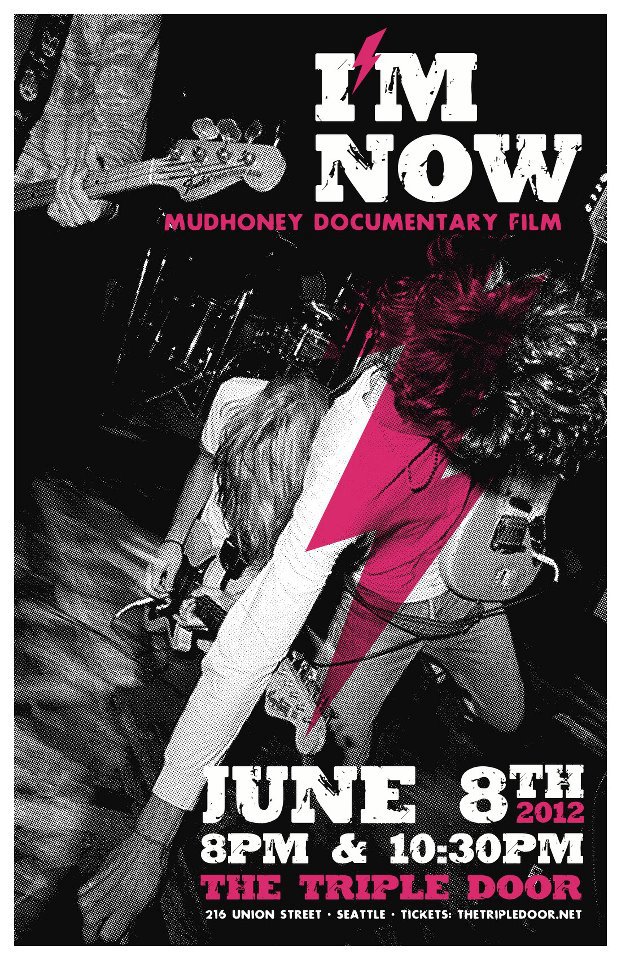
“I’m Now” – An Essential Chapter in Rock History

Seattle is known for many things, not the least of which is spawning Grunge. Most of the bands in the Seattle music scene had very little to do with the ultimately hackneyed word; A word which is far more marketing term than musical genre. Nonetheless, in the early nineties, the title was thrust upon any band in Western Washington with a distortion pedal. One such band was Mudhoney, who inadvertently become Grunge poster boys. They were lumped in with a whole bunch of other bands with which they had nothing in common other than an area code. If it had not been for this stupid, meaningless catchall title, perhaps Mudhoney’s career would have gone much differently. Perhaps they would have had the success they deserve.

Of course, Mudhoney is successful, relatively speaking. But they should have been huge. They probably would have opted out of having crazy, drug-fueled parties at the Edgewater Hotel where groupies were violated with fish and branded with cattle prods (a la Led Zeppelin). But damnit, they should have had the option. At the very least, they should have been credited for being at the forefront of a musical revolution. Yes, they’re that good.

If you live in Seattle, you might be able to score a ticket to the June 8th premiere of “I’m Now”, the feature-length documentary which spans Mudhoney’s entire history and finally gives credit where credit is due. The Triple Door will hold two screenings of the film that night. It’s a beautiful theater and a great place to see this unforgettable film (review follows).

“I’m Now” (2012)
Directors: Ryan Short & Adam Pease
5/5 Stars

If you aren’t a Mudhoney fan when you start watching King of Hearts Productions’ new music doc, “I’m Now”, you certainly will be by the closing credits. The band has a lot to be bitter about. But they aren’t bitter. In fact, they couldn’t be more gracious. These are guys who love to play music and consistently found a way to keep doing it.

Interspersed throughout the narrative are interviews with other Seattle music scene notables including Bruce Pavitt and Jonathan Poneman of Sub Pop Records, Stone Gossard and Jeff Ament from Pearl Jam and Kim Thayil from Soundgarden. But none of these famous faces are as captivating as the band members themselves.

Each of the guys is interviewed separately, getting the chance to tell the story from their individual perspectives. They’re well spoken and clever, and never do they seem at all arrogant or inaccessible.

For me, one of the most refreshing moments is when front man, Mark Arm, speaks candidly about his drug and alcohol issues. He acknowledges the rock n’ roll cliché in which he found himself. But he didn’t have to surrender to any higher power to get through it. It’s not a juicy, “Behind the Music” tale. He just isolated the problem and took care of it. Fuckin’ A.

But it’s not just the interviews that enchant. It’s also the live performances. The footage from these shows is intimate and electrifying. Much of the b-roll is from the band’s own archives, but filmmakers, Ryan Short and Adam Pease, also followed Mudhoney on a recent tour. In 2008, this documentary team cut their teeth on a film about another unsung Seattle band, Tad (“Busted Circuits and Ringing Ears”). With a long resume of music videos, they certainly know how to film a band. As a result, “I’m Now” is the most riveting and reverent music documentary since Julian Temple’s “The Future is Unwritten”. Short and Pease have made an explosive piece of art, fueled by the raw power of Mudhoney’s music, that delivers sweet comeuppance to all the folks who did the band wrong over the years. Treat yourself to the aural and visual intoxication of “I’m Now”. I promise you won’t have any regrets come morning.

NFT Radar: A La Mode Pies

2011 was the Year of the Pie, with shops springing up all over Seattle. Our offerings were even featured on a Food Network special about the rise of the pie across the country. The people had spoken. Cake was dead. They wanted crust and fruit filling and mounds of cream. A la Mode gave competitors a big run for their money. While pie men came and went (R.I.P. Piecycle), they expanded, going from just an online retailer (with home delivery) to brick-and-mortar when they opened their café on Phinney. Now you don’t have to give 24-hours notice to enjoy their incredible desserts, which include crumbly French Apple, Mexican Chocolate Mousse, Bourbon Butterscotch and a Chocolate Caramel Pecan Tart that renders your fork useless with its gooeyness. See their website for more mind-blowing regular flavors and check with the café often for their rotating flavors. Sour Cherry was a recent gladiator in their grand pie arena. You can still order whole pies online for a very reasonable $25, but it’s a lot more fun to mix-and-match slices for the complete a la Mode experience. Don’t forget a quart of Bluebird ice cream from their freezer to fulfill your pie destiny.


Source.

My Seattle

One of the best things about my job at NFT is that people ask me for advice on where to go. If you’re curious about what I usually recommend, I’ve updated my Custom Map with some of my new favorite places, as well as the timeless classics. (Anyone can create an account and do this, BTW.)

See my list and map here.

  • Calendar

    • January 2026
      M T W T F S S
       1234
      567891011
      12131415161718
      19202122232425
      262728293031  
  • Search