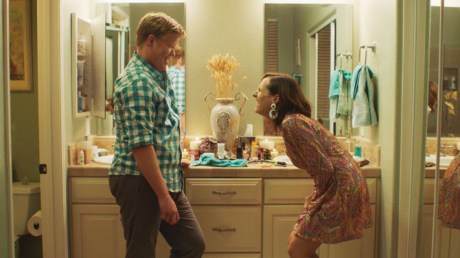
Hammer to Nail Review: How to Plan an Orgy in a Small Town

(The 2016 Slamdance Film Festival is in full swing and we have boots on the ground as well as eyes on screener links for the whole festival! Stay tuned to Hammer to Nail as reviews start rolling in…)

Writer/Director Jeremy LaLonde (Sex After Kids) returns below the belt with his second feature, a bit of good, dirty fun called, How to Plan an Orgy in a Small TownAs the result of a humiliating sexual encounter, teenager Cassie Cranston (Jewel Staite, TV’s Firefly) is almost literally run out of her small Canadian hometown of Beaver’s Ridge. Twelve years later, she reluctantly returns to tie up loose ends after her estranged mother’s funeral and finds that her former peers still hold a grudge. You see, following her exit, Cassie moved to the Big City, and published a scathing piece, exposing Beaver’s Ridge as a wretched hive of wasps and repression. Her article went viral thanks to a literary connection with the town, drawn by her mother, an “Ann of Green Gables” type author, who erroneously depicted the place as wholesome and idyllic. In the years that followed, Cassie gained more notoriety as a sex columnist, further mortifying the conservative townspeople.

What her former peers don’t know, is that Cassie isn’t quite as sexually adventurous as she lets on. And what Cassie doesn’t know, is that the people she grew up around are capable of more open-mindedness than she gave them credit for. Alice (Katharine Isabelle, Ginger Snaps), Cassie’s former best friend, is in the process of exploring her sexuality as she tries to wrap up a divorce with her reluctant husband, Bruce (Mark O’Brien). Heather (Lauren Lee Smith, TVs The L Word) wants to get pregnant ASAP so that she can catch up with the rest of the housewives, and treats her sad-sack husband, Adam (Ennis Esmer), like little more than a baby batter dispenser. And Chester (Jonas Chernick), just finds it difficult to get laid when he feels like he already knows everyone around him. So, for various reasons, they all agree to plan the titular orgy, with Cassie as their guide. She, in turn, will make it the subject of the contractually obligated book she is long overdue writing…

Read the rest on Hammer to Nail!

Hammer to Nail Review: Chemical Cut

(The 2016 Slamdance Film Festival is in full swing and we have boots on the ground as well as eyes on screener links for the whole festival! Stay tuned to hammer to Nail as reviews start rolling in…)

Chemical Cut is the more-than-semi-autobiographical first feature written, directed by, and starring former America’s Next Top Model contestant, Marjorie Conrad. But this isn’t a dramatic reenactment of her time under the tutelage of Tyra Banks, nor is it a straightforward account of Marjorie’s experiences attempting to forge a modeling career after ANTMChemical Cut is about modeling, but it’s moreover the tale of a sheltered young woman attempting to thrive in a hostile world and discover her true self.

23-year-old Irene (Conrad) is indecisive about her career, but she knows she doesn’t want to stay in her dead-end retail job. So when, thanks to a dramatic new hairdo, she is scouted by a modeling agency, she decides to give it a try. She is immediately met with opposition, as well as discouragement from her parents and her emotionally abusive childhood friend, Arthur (Ian Coster). Her new agent is grotesque in both appearance and personality. And though he bombards her with dehumanizing criticisms the moment she walks in the door, she decides to stick with it, determined to make the most of the “one good year” she has left to be a model…

Read the rest on Hammer to Nail!

Hammer to Nail Review: Bread and Butter

That line from Clueless popped into my head repeatedly as I watched Liz Manashil’s filmmaking debut. Brittany Murphy delivers the “way harsh” insult to Alicia Silverstone as a means for discrediting her. If you’re a virgin who can’t drive, who are you to give someone life advice? Of course, those characters are teenagers, so they aren’t exactly brimming with wisdom. Amelia (Christine Weatherup), the protagonist of Bread and Butter, is thirty years old.

Early on, Manashil cleverly establishes Amelia’s desire to “live in a French movie”. This sets the audience up to expect a certain quality of whimsy (that her name is so close to Amelie can’t be a coincidence). When she finds an annotated novel in a used bookshop, and vows to meet the man behind the notes, you think you know what’s coming. But Amelia is no Manic Pixie Dream Girl. She’s more like a Manic Normal Human Woman. And Bread and Butter, is a romantic comedy about what dating is really like for socially inept oddballs…

Read the rest on Hammer to Nail!

Hammer to Nail Review: Circle

(The 2015 Seattle International Film Festival started May 14 and ran all the way until June 7. HtN was on the scene and a festival wrap-up is coming later this week. In the meantime, check out this review of Circle, the latest from filmmakers Aaron Hann and Mario Miscione).

Circle is the most fun you can have watching a diverse group of strangers get systematically executed. Aaron Hann and Mario Miscione crafted a shrewd script for their Twilight Zone inspired morality tale about fifty people who are forced to stop being polite and start getting judgmental.

It begins with everyone returning to consciousness after a blackout, to discover that they are standing in a circle, facing each other, in a dark room. They soon learn that they cannot move too much or try to step off the red dots under their feet, lest a machine in the middle of the room electrocutes them. And that’s not even the bad news. Every two minutes, the machine also kills one person at random. They can’t stop the death, but they do have the power to choose the next victim by popular vote. There are other rules and nuances that they ascertain along the way, all of which play into their harrowing discussion about who should be the next to die and if “winning” this sadistic game is even an option…

Read the rest on Hammer to Nail!

Hammer to Nail Review: Sleeping with Other People

(The 2015 Seattle International Film Festival started May 14 and runs all the way until June 7. Keep an eye on HtN for several reviews like this one, the latest from Writer/director Leslye Headland).

Writer/director Leslye Headland’s Sleeping with Other People is a Rom-Com that exists in the space between sincerity and satire. It’s hard to top Headland’s own description: “When Harry Met Sally for assholes.” But if you were truly an asshole, you’d be annoyed by the film’s frequent moments of earnestness. Moreover, fans of that saccharine, genre-defining film might have trouble empathizing with Headland’s deeply flawed protagonists. With its sexual implicitness, casual swearing, and unabashed recreational drug use, Sleeping with Other People is more akin to the films of Judd Apatow and Nicholas Stoller than to Rob Reiner…

Read the rest on Hammer to Nail!

Hammer to Nail Review: Glassland

(The 2015 Seattle International Film Festival started May 14 and runs all the way until June 7. Keep an eye on HtN for several reviews like this one, the latest from Irish filmmaker Gerard Barret).

Irish filmmaker, Gerard Barrett  follows up his acclaimed first feature Pilgrim Hill with Glassland, another peek into the hardships of life in working-class Dublin. John (Jack Reynor, Transformers: Age of Extinction) is a young man struggling to hold his family together thanks to his mother, Jean’s (Toni Collette), full-blown alcoholism. She drinks like it’s her job and so it becomes John’s job to keep her alive and the family above water. He occasionally attempts to blow off steam in the company of his best friend, Shane (Will Poulter), who is going through some heavy stuff of his own regarding his estranged newborn son. Glassland is an incredibly bleak and intense 90 minutes that haunts you for days after. The lasting impression it leaves is especially remarkable considering the budget and time constraints under which Barrett worked…

Read the rest on Hammer to Nail!

FILM THREAT INTERVIEW: THOMAS BEATTY & REBECCA FISHMAN of “THE BIG ASK”

Premiering at the 2013 Seattle International Film Festival, “Teddy Bears” enjoyed a festival tour before Tribeca Film picked it up for distribution, changing the title to “The Big Ask” in the process. The fickle desert of Joshua Tree serves as the ideal backdrop to the (somewhat) true story of a man (David Krumholtz) who surprises his friends during their vacation with his nervous breakdown in the form of an indecent proposal. I reviewed the film when it played at SIFF and it was one of my top picks from the festival that year. I was pleased to hear that “The Big Ask” would reach a larger audience thanks to its V.O.D. release on June 30th. I recently caught up with co-directors/married couple, Thomas Beatty and Rebecca Fishman, at their home in Los Angeles where they were still adjusting to having a new human baby on top of promoting what they consider their first-born, a feature film.

Continue reading

2014 SEATTLE INTERNATIONAL FILM FESTIVAL WRAP-UP

As you may or may not know, the Seattle International Film Festival is the largest film festival in the world. This year, they screened 435 features and short films from around the globe. As you can imagine, it’s impossible to see everything, so I try my best to curate my personal program wisely. Unfortunately, even an awful film can have a great idea at its core so I am sometimes duped by a promising synopsis. Thankfully, my dance card contained way more great films than stinkers this time around. Here are the best and worst of the 20 or so films I squeezed into the festival’s month-long run:

BEST:

“The Babadook” – This Australian export, akin to “Rosemary’s Baby”, is one of the best horror films I’ve seen in years. It tells the story of a widowed mother who questions her own sanity when her behaviorally impaired son becomes obsessed with a morbid children’s book that mysteriously appears on his book shelf. Supernatural though it may be, “The Babadook” also hauntingly examines grief in the face of senseless tragedy. Try not to watch it right before bed.


“Happy Christmas” – Joe Swanberg is one of the founders of Mumblecore, and with every new film, he makes a better case for genre MVP. If you liked “Drinking Buddies”, you will certainly love “Happy Christmas”, which stars versatile minx Anna Kendrick as a hot mess who gifts her brother and his burgeoning family with her post-breakup meltdown during the Christmas holiday. Swanberg also stars alongside his real life baby and the long-underutilized Melanie Lynskey (“Heavenly Creatures”, “Foreign Correspondents”) as a writer who has put her career on the back burner in order to stay at home with their son.


“In Order of Disappearance” – Comparisons to “Fargo” extend beyond the prevalence of snow, in this Norwegian film from director Hans Petter Moland. Star Stellan Skarsgaard channels Liam Neeson in this humor-speckled revenge drama in which an unassuming snowplow driver systematically hunts down the men responsible for murdering his son.


“Mood Indigo” – However you stand on the work of French director Michel Gondry (“Eternal Sunshine of the Spotless Mind”), you have to admit that he is always innovating. His latest film is his most experimental yet. It’s “Pee-Wee’s Playhouse”-meets-“Synechdoche, NY” aesthetic left the entire theater in a surreal daze, as if they had sprinkled shroom dust on the popcorn. It’s not his masterpiece, but it is required viewing for anyone who is remotely interested in experimental cinema.

“Night Moves” – Kelly Reichardt is a true cinematic auteur and her latest film induces a lingering performance from Jesse Eisenberg as one third of a trio of eco-terrorists (alongside Dakota Fanning and Peter Skarsgaard) who are blindsided when they fail to consider the full implications of their actions.


“Skeleton Twins” – Bill Hader and Kristin Wiig are unbelievably brilliant in this black comedy about estranged twins who begrudgingly reunite following simultaneous suicide attempts. It’s entirely possible that this movie would be completely devoid of humor (and sympathetic characters) without the two leads. But because it’s Hader and Wiig (quite possibly the most natural comedic actors on the planet.), you love them and want them to be happy despite their self-destructive idiocy.


“Obvious Child” – I saw this at another festival but I really can’t say enough nice things about Jenny Slate’s killer multi-layered performance in the funniest romantic dramedy about abortion in recent memory.

WORST:


“Alex of Venice” – I hate to put Chris Messina’s directorial debut in this category, because it’s a masterwork in comparison to my other two Worst of Fest choices, but in the grand scheme of things, it’s not a very good film. Messina attempts Cassavetes vérité, but the hackneyed dialog betrays him. Performances by Mary Elizabeth Winstead and Don Johnson (going for a late-career dramatic turn a la Tony Danza) are as good as they can be under the circumstances.


“Another” – A large part of me just wants to forget I ever saw this movie. And in time, I’m sure I will. But I am compelled to put out one more warning to stay the hell away from this amateurish, nonsensical, misogynistic pile of poop. It’s not so bad it’s good. It’s just SO BAD.

“Zombeavers”– The title is absolutely the best thing about this failed attempt at b-movie camp. If you like relentless entendres about hairy vaginas, you still won’t like this movie.


HONORABLE MENTIONS:


“An Afternoon with Laura Dern” – I thoroughly enjoyed this professionally moderated Q&A with one of my favorite actresses following her receipt of SIFF’s Outstanding Achievement in Acting Award. In addition to her immense talent, Dern is lighthearted, humble and as savvy about film as she is enthusiastic. A screening of David Lynch’s “Wild at Heart” followed the Q&A, featuring one of Dern’s most memorable roles as the sweetly rebellious and philosophical Lula Fortune.


“To Be Takei” – From sci-fi cult hero to nerd national treasure, George Takei has reinvented himself numerous times throughout his career. Jennifer Kroot paints a respectful portrait of a relentlessly optimistic and talented man who has used his charm to advance the LGBT equality movement.

“Venus in Fur” – Roman Polanski’s latest is a compelling, if on the nose, portrait of a self-obsessed director and playwright who doesn’t realize he’s met his match in a seemingly naïve actress auditioning for the lead role in his adaptation of the Leopold von Sacher-Masoch novel. Hyper meta though it is, (it’s a play within a play about a novel within a novel), the story still manages to be fairly straightforward and accessibly clever.


“Willow Creek” – Accurately described by many (including writer/director Bobcat Goldthwaite) as “The Blair Sasquatch Project”, this found footage horror film surpasses its predecessor with compelling characters and story structure, but falters at the very end.


GOLDEN SPACE NEEDLE AWARDS:

Richard Linklater’s “Boyhood”, swept the Golden Space Needle awards, earning accolades for best director, best actress (Patricia Arquette) and best damn film period. Alan Hicks took home Best Documentary with “Keep on Keepin’ on”; an account of jazz legend Clark Terry’s mentoring of blind piano prodigy Justin Kaulflin. Cody Blue Snider’s “Fool’s Day” took home the award for Best Short.

SIFF is a film festival marathon. It’s exhausting and occasionally painful, but ultimately very rewarding. Thank you to SIFF for another great fest. Time to catch up on my DVR and then start training for next year!

Originally published on FilmThreat.com (now defunct).

FILM THREAT REVIEW: LUCKY THEM

2014 SEATTLE INTERNATIONAL FILM FESTIVAL SELECTION!
Rated R
97 minutes

***

Megan Griffiths’ most commercial film to date, the acclaimed director departs from the weightiness of her previous work (“Eden,” “The Off Hours”) with “Lucky Them”. Part indie darling, part wacky road trip movie, it’s not nearly as authentic as her earlier films. But it’s at least engaging enough to keep you watching, if only to learn the resolution of the story’s core mystery.

Toni Collette effortlessly slips into the role of Ellie Klug, a mid-forties rock journalist who is experiencing a rut in all aspects of her life. Ellie is short on necessary cash for her potentially career-saving investigation into a 10-year-old cold case: the disappearance of Matthew Smith, an iconic Seattle musician and Kurt Cobain/Elliott Smith hybrid. The story carries extra weight for Ellie because she was in a serious relationship with Smith at the time of his disappearance and she has been unable to fully process the loss.

The film’s other prominent character is Charlie (Thomas Hayden Church), a former boyfriend and eccentric wealthy layabout who attaches himself to Ellie after a chance reunion. Charlie agrees to fund her mission provided she allows him to turn it into a documentary.

Meanwhile, Ellie feebly resists a relationship with a cute, younger street musician on the brink of stardom (Ryan Eggold). It’s his singer-songwriter aesthetic that also makes up the film’s largely ignorable soundtrack.

The story is reportedly semi-autobiographical for co-writer Emily Wachtel. Though, with several implausible plot points, perhaps it’s not autobiographical enough. For starters, do people like Ellie really still exist? She writes for what must be the last independent print music rag in the country. Her editor (Oliver Platt) is so convinced of the story’s revitalizing properties that he threatens to fire her if she refuses to take the assignment. The failing magazine is responsible for Ellie’s sole income, yet she somehow makes enough money to live alone in an apartment in the middle of one of the most expensive cities in the country and seems to enjoy a vibrant night life.

Though Collette and Hayden Church manage to imbue their characters with their natural charisma, on paper, they are tropes. Ellie is the self-destructive control freak that is afraid to open up. Charlie, with his freewheeling attitude and emotional candor, acts as Ellie’s foil. Initially, he is the wisecracking sidekick who eventually reveals a deep soul, thereby teaching Ellie to feel ways about things. It’s a relatively entertaining story, but the character development errs on the side of heavy-handed.

If you can get past these shortcomings, you will likely enjoy the rest of the film. Griffiths is a talented director with a distinctive knack for finding locations with character. She does a terrific job of capturing the true Seattle scenester vibe, avoiding shots of the Space Needle and fish throwing.

The bottom line is that based on her resume, I expected more from Griffiths. I hope that in the future she sticks with the more vérité tone of “The Off Hours” and steers clear of this Cameron Crowe, Hallmark hipster territory.

Originally published on FilmThreat.com

FILM THREAT REVIEW: RAZING THE BAR

2014 SEATTLE INTERNATIONAL FILM FESTIVAL SELECTION!
Unrated
83 minutes

****

Ryan Worsley’s debut documentary lovingly profiles a now defunct Seattle bar and night club called “The Funhouse.” But her film is more than just a scrapbook. It also explores how much a place like that means to the community that embraces it and critiques the morality of gentrification which often means the death of DIY institutions.

As “Razing the Bar” illustrates, the Funhouse was more than just the divey rock and roll bar that dared to stare down Paul Allen’s Experience Music Project in tourist-laden Seattle Center. To the uninitiated, it was “the scary clown bar,” but to a group of entertainment misfits, it was a hangout, a home and an incubator. You didn’t have to be fully formed to play there, and for many young bands, it was the “first show that mattered” thanks to receptive audiences and a talented and fair booker who always made sure his acts ended the night with dollars in their pocket and a place to crash.

That booker, Brian Foss, is also the protagonist of the story. To many, the Funhouse was Foss. Worsley makes this clear through interviews with Funhouse alumni, peppering their anecdotes with photo collages, old show footage and scores it with the music of the bands who played there. One former patron calls it the Punk Rock Cheers, which perfectly sums up how much it meant to so many people.

The story of the Funhouse extends beyond the local scene. Every great city needs a place like the Funhouse, an indispensable part of the underground entertainment scene. Regardless, the building was sold in 2012 and razed to make way for luxury apartments, an all-too-common story in many burgeoning cities. Seattle is one of the fastest growing cities in America, so it makes sense that these new transplants would need somewhere to live. But the tragedy is that it is at the expense of the spirit of the city, which makes it a unique and desirable place to live in the first place.

As one interviewee points out, many of the musicians celebrated in the EMP would have relied on a place like the Funhouse to showcase their early work. Little by little, we lose the small venues where the next Kurt Cobain could play. Many credit the Funhouse to the current Cabaret and Vaudeville revival.

The Funhouse wasn’t just a springboard for acts. One of Foss’ apprentices started there at a very rough time in her life. Today, she holds a prominent position at Austin City Limits, one she never would have been considered for as a drug-addled runaway.

Despite the inevitable destruction, “Razing the Bar” does have a happy ending. The communities that formed at the Funhouse are still as active and close-knit as ever. Foss also continues to book shows for two like-minded clubs around town. He’ll carry the torch as long as he can. The Funhouse may be gone, but the spirit lives on in all those who touched its sticky floors.

Originally published on FilmThreat.com (now defunct).