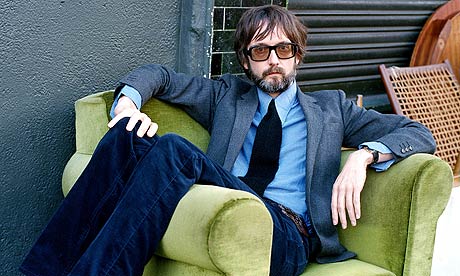
Hotter with a Beard: Jarvis Cocker Edition

Now I know what you’re thinking. That voice! Those dance moves! The sharp-as-hell wardrobe! Jarvis Cocker is already an 11 on the 1-10 hotness scale. How could he possibly get any hotter? Well, feast your eyes on this:


Christ on a cracker! Hey Jarvis…Wanna turn that easy chair into a love seat?

If you need further proof, here he is throwing shapes at Coachella:

I’m pleased as punch to say I was there to witness it.

I’m sure you are convinced by now. But let’s see a few more pics for your Friday afternoon delight:

Could this be his O Face? Only a few lucky ladies in the world can say for sure:

Aaaaaand I’m spent. Time for a cold shower!

Film Threat Review: The Five-Year Engagement

2012
Rated R
124 minutes

**

I suppose that when a film is called “The Five Year Engagement,” one should expect a certain amount of foot-dragging in the narrative. Before we watched the film, my husband joked that he hoped it wasn’t shot in real time. It’s not. But, unfortunately, it often feels as though it is. Turns out, it’s not a lot of fun to watch a relationship fall apart even if you know that eventually, everything will turn out just fine.

We join the too-cute couple, Tom (Jason Segel) and Violet (Emily Blunt), on the night of the proposal. Despite pitfalls at every step of Tom’s elaborate engagement plan, Violet accepts. But, as the title suggests, their journey to matrimony is not without a lengthy series of unfortunate roadblocks. The first is the shotgun wedding of Violet’s sister Suzie (Alison Brie) and Tom’s best friend Alex (Chris Pratt). The unlikely couple hooks up at the engagement party and, with one pee stick, manages to take the wind out of Violet’s wedding planning sails.

Then, Violet’s master plan is thwarted when she receives a rejection letter from the Berkeley post-doc program. She decides she can re-apply in a year and really focus on the wedding, until she gets accepted into the University of Michigan. It’s amazing how quickly and easily she convinces herself that this is a viable alternative. Despite Tom’s burgeoning career as a chef in San Francisco, and their general happiness in the city with their friends and family, moving to Ann Arbor suddenly becomes the be-all for Violet’s aspiring tenure track. She goes through the motions of talking it over with him, but it’s clear she’s already made up her mind.

Tom and Violet had only been together a year when they got engaged, so they never had much of a chance to get used to melding their lives together. Instead of coming up with a mutually beneficial solution, Tom concedes to Violet, cocooning his resentment and disappointment so that it may emerge in the third act, a fully formed Mothra of relationship devastation. This isn’t unrealistic. On the contrary, it’s a little too on the nose. Apart from a few jokes about penis shrinkage, it’s mostly Dramarama for these two.

Rest assured, there is more to the film than cantankerous couple voyeurism. Jason Segel and his “Muppets” writing partner, Nick Stoller, also mix in plenty of saccharine sincerity alongside the cringingly realistic arguments that a couple has when one half has put their own dreams on hold for the sake of the other.

There are also all the drunken shenanigans, dick jokes and random violence that we have come to expect from the Apatow brand. The supporting cast does all the comedic heavy lifting. It’s so polarized that I often wished the film were ONLY about Tom and Violet’s friends and family. Just as Suzie and Alex steal the show from Tom and Violet with their shotgun wedding, Brie and Pratt steal the movie from Segel and Blunt. In both cases, the theft is inadvertent, but the superiority of the pairing cannot be denied. I’m convinced that Alison Brie is some kind of acting superhero what with her ability to nail any acting feat, including a passable British accent. Meanwhile, Chris Pratt plays a slightly more perceptive version of his “Parks and Rec” counterpart, imbuing every line with equal parts hilarity and sincerity.

If they didn’t steal the show, someone else would have. Viable candidates include Lauren Weedman as Tom’s butch boss, Mindy Kaling as one of Violet’s classmates and Brian Posehn and Chris Parnell as Tom’s Michigan pals. Even Tim Heidecker, Kumail Nanjiani and Molly Shannon, whose combined screen time total that of Jason Segel’s bare bottom, are far more enthralling in their cameos than any of Segel or Blunt’s scenes together.

Additionally, I feel kind of bad for the state of Michigan. The characters shit on it in scene after scene. The narrative montages through the temperate seasons, stopping only in the wintery months. Nearly every establishing shot includes a gray pile of slushy snow. Winters there would be hard on a naturalized San Franciscan, but absolutely no one seems happy to live there. When Tom searches for a sous chef job, he is consistently laughed out of the restaurants for having left his job in the Bay Area. Even people who have embraced the local color (which apparently involves running shirtless through the streets in collegiate support, cross-bow hunting, unkempt facial hair and home-brewed mead) make frequent jabs at their home state, which I doubt is as dreary and backwoods as the screenwriters would have us believe.

But here’s the biggest problem with “The Five-Year Engagement”: When film moguls reach a certain level of fame, they become incontestable. Everything they touch is deemed gold, even if it is, in fact, a pig in turd lipstick. Given my love for “Freaks and Geeks,” I really hate to say it, but I’m afraid Judd Apatow has become one such Faux Midas. I’ve said it before and I’ll say it again. No comedy needs to be longer than 90 minutes. Period. Even “Bridesmaids”, an otherwise terrific film, had some noticeable fat to trim. But here, the excess is blindingly apparent. Let’s start with cutting all the cliché shots of the Golden Gate Bridge and streetcars, which open the film with the sole purpose of establishing location, when a single line would have sufficed. I lose track of how many times we flashback to the moment when Tom and Violet met, but anything more than once is too much.

Many jokes are driven into the ground so deep, they come out the other side. We get it. Everyone in the Apatowverse is a supernaturally talented improviser. Simply filling your film with talented people does not give you a license to just let them “do their thing” unfettered. Actors need fettering (especially actors who double as screenwriters). There is a reason why people take classes on how to write and make movies. It’s because there are rules. I’m not saying it’s never OK to break the rules. But you should have a comprehensive awareness as to why you’re doing it. For the record, just REALLY liking a scene is not a good enough reason.

There is also the sad fact that Jason Segel’s raunchy, lovesick puppy dog shtick is wearing thin. In fact, the entire Apatowverse is. Bawdy rom-coms are no longer a novelty hand. Unfortunately, it appears that these folks have no other cards. Perhaps it’s time to let someone else play.

Originally posted on FilmThreat.com (now defunct).

Cookbook Review: Quinoa Cuisine

Not to brag or anything, but I’ve been into quinoa since before it was cool. I grew up with a slightly hippie mom who forbade sugar cereals and soda and thought that carob was an acceptable alternative to chocolate. We also rarely had red meat. She provided proteins from fish, chicken and tofu and, of course, quinoa. I became a vegetarian when I was 14 and finally began to appreciate my mother’s health-conscious ways. Because of her, I already had several healthy recipes under my belt. Of course, it never hurts to have more.

Quinoa has been very popular, of late. David Lynch even cooked up a bowl as a special feature on the “Inland Empire” DVD. And now we have Jessica Harlan and Kelley Sparwasser’s terrific cookbook, “Quinia Cuisine”, which boasts “150 Creative Recipes for Super-Nutritious, Amazingly Delicious Dishes”. If you’re skeptical about quinoa, that claim might sound like a bit of an oversell. Perhaps it’s because there are still a lot of people out there who are suspicious of it. I can understand why. It looks weird. It smells a little strange before you cook it and especially before you give it a good rinse. But trust me when I tell you that this strange little food really can be “amazingly delicious”.

“Quinoa Cuisine” is a terrifically laid out cookbook with an unusually worthwhile introduction, outlining its history and health benefits as well as many cooking methods and a few factoids. For instance, did you know that quinoa is NOT actually a grain? I did not. Apparently, it’s more closely related to beets, spinach and chard. What you’re actually eating is quinoa seeds, thus making it a “pseudograin”. I won’t spoil the whole thing for you. I’ll just say that I usually skim over introductions to pretty much every book I read. Not this time.

The actual recipes in the book are coded with helpful symbols that indicate such qualities as “30-minutes or less”, “gluten-free”, “kid friendly” and vegan or vegetarian.

The first chapter consists of “Essential Recipes” which are not only recipes you’ll make often, they also appear as part of other recipes later in the book. This is where you might begin to realize the true magic of quinoa. You can make every damn thing with it, from pancakes to pizza dough, tortillas to pie crust. If you’re living gluten free and didn’t know about quinoa this book will probably change your life.

From there, the book moves through every meal, blowing your mind with options: Breakfast, Starters, Salads, Soups & Stews, Side Dishes & Pilafs, Meat & Fish, Vegetarian and even Dessert. There are also special sections for Packed Lunches and Party Food. This is a truly comprehensive book that transcends genre and cuisine ethnicity. Think of your favorite dish. I’ll bet you cash money that there is some version of it in there. And, as a side bet, I wager that you’re going to love it made with quinoa. Maybe I have a little bit of a gambling problem. But that doesn’t mean I’m not right about this.

My one complaint with this book is that, apart from the front and back covers, there aren’t any photos of the food. I’m a visual person and I always like to compare my completed dish with the photo in the book, just to make sure I did it right. Granted, I get kind of annoyed with the step-by-step photos that food bloggers are so fond of. I don’t need to see what all my ingredients look like laid out on the counter together. But a little food porn is what often draws me to a recipe. I know they probably wanted to make more room for recipes (and possibly to save money by printing in black and white). But I wouldn’t mind a slightly higher cover price for the benefit of one little picture for each recipe.

Apart from the lack of photos, I am perfectly pleased with “Quinoa Cuisine” and highly recommend it to anyone who is already a fan or even a little quinoa curious.

SXSW Review: Jeff

2012 SXSW INTERNATIONAL FILM FESTIVAL REVIEW!
Unrated
79 minutes

****

The film opens on a very lengthy shot of a fish tank. The camera pulls back to reveal a man with large glasses and an unsettling mustache. He’s clearly an actor portraying serial killer Jeffrey Dahmer, the necrophiliac cannibal who was convicted of the murder of seventeen men. “Is this not actually a documentary?” I wondered. Chris James Thompson could have made a dramatic narrative film. But he decided instead to get to the meat of the story by patching together reenactments from Dahmer’s quiet public life with first-hand accounts from the people who inadvertently got to know him better than anyone. The film doesn’t depict Jeffrey Dahmer’s human side, but rather, it shows a very detailed picture of the mask of humanity which he wore every day.

Although Thompson found an apt actor to play Dahmer (Andrew Swant), the interview subjects are best experienced first-hand, especially Dahmer’s former neighbor, Pamela Bass, and the lead police officer on the case. The two of them are characters in their own right. They, alongside the lead medical examiner, became three of Dahmer’s living victims.

Dahmer and Bass shared a seemingly ideal neighborly relationship. She would hang out in his apartment and they would chat over sandwiches that he made. The potential contents of those sandwiches, as well as a generally shocking breach of trust, still haunt her. They would greet each other in the hall and then he would get back to dismembering bodies on the other side of the wall that they shared. She has enough nightmare fodder to last the rest of her days.

The lead medical examiner, Dr. Jeffrey Jentzen, had the unfortunate job of sorting through the body parts they found stashed all over his apartment and attempting to assemble identifiable corpses. The audience hears about the head in the fridge and the jar full of penises, but we can only imagine how horrifying it must have been to have to get up close and personal with the atrocities that Dahmer committed.

The real star of the film is the police officer that led the investigation. Pat Kennedy is an engaging storyteller with a commanding mustache. He played the good cop during his three-day interrogation and eventually coaxed out a confession. But Kennedy’s involvement in the case bled into his personal life. In fact, the famous striped shirt that Dahmer wore during the trial was on loan from Kennedy’s son. Because of his weirdly congenial conversations with Dahmer, his co-workers joked that they were in a relationship. Meanwhile, the media frenzy and the long hours he kept put a tremendous strain on his family life.

Perhaps inspired by TV serial killer Dexter Morgan, the reenactments portray Jeff as he goes about his day. But unlike “Dexter,” it skips over the dastardly deeds showing only the casual way that Jeff runs normal errands alongside murderous ones. Through these scenes, the audience experiences what the rest of the world would have seen: A pleasant, if slightly curious, man going about his business.

His sinister errands, including buying a large barrel and dozens of bottles of bleach (and then carrying them home on a bus), were apparently not blatant enough to arouse suspicion. However, you’d think a hotel clerk would think something of a man who enters with a very light suitcase and leaves with a very heavy one. These scenes are an illustration of the classic account that witnesses give after a serial killer is caught. “He seemed so normal.”

Thompson’s documentary isn’t perfect, as it does leave an uninitiated audience wanting to know more. But it is definitely a good companion piece to the more traditional, informational documentaries out there. “Jeff” the film is a lot like Jeff the man. It seems nice and normal, but it leaves you with an unsettling feeling after you part company.

Originally published on FilmThreat.com (now defunct).

SXSW Review: Sun Don’t Shine

2012 SXSW INTERNATIONAL FILM FESTIVAL SELECTION!
Unrated
90 minutes

***

Every once in a while, an indie film will come along that receives universal praise. It will be the talk of the town and win awards. And then I will see the film and find myself disagreeing with everyone else. This is the case with “Sun Don’t Shine.” The weird thing is, I can absolutely see where all the film’s cheerleaders are coming from.

Writer/director Amy Seimetz oozes talent. Likewise the actors portraying the young couple on the lam have got some chops. I like the way the story unfolds slowly and what they’re running from reveals itself over time. What I can’t stand is Crystal (Kate Lyn Sheil), the shrewish and infantile simpleton that is the film’s female protagonist. Unfortunately she is in nearly every scene, whining like a mosquito and completely detracting from what is otherwise a very good movie.

I realize that she is like that for a reason. “Sun Don’t Shine” is clearly an antidote to the Hollywood portrayal of young criminals in love and on the road. This formula often turns out pretty well (“Wild at Heart,” “Natural Born Killers,” “True Romance”), but it also makes for a very stylized and glamorous portrayal of the depraved duo.

Thus, I do appreciate the truthful approach that Seimetz has taken and she succeeded on many levels. While not unattractive, Crystal and her beau, Leo (Kentucker Audley), are far from glamorous. They wear dirty, ill-fitting clothes and are perpetually drenched in sweat. Not the sexy Antonio Banderas kind of sweat either. You can almost catch their stench through the screen.

There’s nothing much sympathetic about Crystal or Leo. Still, I can look past many character faults in a compelling story. But there is just something about Crystal that rubs me the wrong way. Crystal is not of sound mind and body, but even a crazy person should recognize the magnitude of the favor in question. Instead of being grateful for Leo’s help, she just whines and mopes around. She makes dangerous mistakes and awkwardly attempts to seduce him whenever things aren’t going her way. She has all the sexiness of a scared adolescent girl in her mother’s makeup.

While they kill some time at a bar, Crystal follows Leo around like a puppy. Leo keeps pounding the drinks while Crystal yaps away and tries to throw her vagina at the problem. Most of the time, Leo doesn’t even seem all that interested, but there must be some reason why he’s sticking around. He is astonishingly patient with her considering the amount of pressure he is under. Though he does get fed up on occasion, such as in the explosive opening scene where the two of them fight in a mud puddle like wild animals. I can’t say I blame him. After all, she is the reason they are in this mess.

There is only one other female character in this film, and she too has a strange, infantile seduction technique. If a man had directed, I might suspect him of misogyny. Crystal is so shrill and grating. She’s not quite Kate Capshaw in “Indiana Jones and the Temple of Doom,” but she’s not far off. However, since a lady was at the helm of “Sun Don’t Shine,” I’m going to have to assume that this is just the sort of thing Leo is into. Maybe it’s a masochism thing.

The look of the film is very unique and surprisingly beautiful despite muted colors and frequently overcast skies. The camera stays tight on the action, heightening tension and keeping the audience in the thick of it. Synecdoche shots of the underside of a steering wheel or the road through the bottom of the windshield help to convey the tediousness of road trips and are also a beautiful way to transition to the next scene. It’s been done before, but Seimetz’s composition and smooth editing make it feel brand new.

Chances are, you’re starting to think this sounds like a pretty good movie. And you’re mostly right. In fact, it seems more likely than not that you will LOVE it. Everyone else does. I would too if I could stand the character who occupies 90% of screen time. I truly look forward to seeing what Amy Seimetz does next. I just hope it doesn’t involve Crystal.

Originally published on FilmThreat.com (now defunct).

SXSW Review: Wonder Women – The Untold Story of American Superheroines

2012 SXSW FILM FESTIVAL SELECTION!
Unrated
65 minutes

*****

I’m willing to bet that “Comic Book Heroines” has never been a category on Family Feud because Wonder Woman is not only the obvious answer, it’s practically the only answer. Meanwhile, mainstream films have spent so much time and money on male superheroes that they have to mine the dregs for new franchises. It boggles the mind that we have a Green Lantern movie and yet, we have never managed to bring Wonder Woman to the big screen. (And no, “Catwoman” and “Electra” do not count.) As least now we have “Wonder Women! The Untold Story of American Superheroines.” This thought-provoking and inspirational documentary about what a superheroine could and should be is a good start.

Kristy Guevara-Flanagan’s film covers the history of the best-known comic book heroine and how the image of strong women has morphed in the media since William Moulton Marston created her in 1941. There are so few female comic book protagonists (super or otherwise), that Guevara-Flanagan has to include basically all media to have enough to talk about. We have had some proud moments (“The Bionic Woman,” Ripley, “Buffy the Vampire Slayer”) and some embarrassing moments (The Spice Girls). Regardless, when you stack it all up against the sheer volume of male-oriented stories, it pales in comparison.

“Wonder Women” asks a lot of seemingly obvious questions that have somehow eluded us. One such question is, “What are the consequences when women become strong.” For women, there are always consequences. The film gives us a staggering statistic: Of the 157 female characters in action films, half are evil. The ones who are good end up dying in self-sacrificing ways, giving their lives for the dominant male heroes of the story. When Jean Gray becomes Dark Phoenix in “X Men: The Last Stand,” she is the most powerful mutant of all. But, because of her womanly ways, she is too weak, both mentally and physically, to control that power. And so she must die. The body count that Thelma and Louise leave behind is a drop in the bucket compared to what the Punisher gets done before breakfast. And yet, they have to die because there is no room in the world for a couple of lady vigilantes. After fighting tooth and nail for 3 films, Ripley ends up killing herself to save a fucking men’s prison colony.

In case you couldn’t tell, “Wonder Women” got me really riled up. The fact that women are mis/underrepresented in media is not news, but when you see it all laid out in chronological order like that, it’s pretty infuriating. Interviews with Lynda Carter (the “Wonder Woman” TV show) and Riot Grrrl pioneer Kathleen Hanna explore how the culture changed over time. “Ms. Magazine” founder and famed feminist, Gloria Steinem, beautifully orates how important it is for young girls to have super role models. Indeed, the film is filled with interviews with a multitude of smart, eloquent women explaining what should be evident but is so not: Girls need super heroes because they need to know that their gender is not an obstacle.

To drive the point home, the film also spends time with a couple of whip-smart young fan girls as well as a woman who wants to share Wonder Woman’s message of “Justice, compassion and friendship among women” with her daughter. She has a tattoo of the Amazon goddess to remind her every day of her own strength.

It’s not just the message of Guevara-Flanagan’s film that stirs. This is a well-paced and beautifully edited documentary, which deftly utilizes clips and photo animations. With a paltry 65-minute run time, it’s the first time in recent memory that I have wished a film were longer. This just drives home how parched we are for quality female-helmed and oriented films.

The good news is that there are some promising up-and-comers. They spend some time with students in a Seattle film program for girls. The students make their own film from start to finish. There are some very talented young ladies nipping at the heels of that big boy’s club known as the Film Industry. Here’s hoping they are able to break down the penis-enforced wall. Better yet, I hope that by the time they graduate from film school, their gender isn’t an issue at all.

It’s the personal stories that really got to me. I’m a tough nut to crack in terms of crying at a movie, but when the little girls started talking about what Wonder Woman means to them and how their moms are the real heroes, it was Niagara-fucking-Falls. If you have a daughter, it is a moral imperative that you show her this film as soon as possible. One little girl says that her mom “basically saves people every night” as a paramedic and that she would like to someday do the same. A fourth grade girl with a slight speech impediment talks about how Wonder Woman helps her through the pains of adolescence. “Sometimes I get picked on at school,” she says. “But I just tell myself, ‘Keep going, keep going, you’re going to be more.’ Because some day they’re going to be wishing that they treated me better.” You’re goddamned right they will, kid.

Originally posted on FilmThreat.com (now defunct).

SXSW Review: Girls Against Boys

2012 SXSW FILM FESTIVAL SELECTION!
Unrated
87 minutes

*

I don’t know why Austin Chick decided to attempt a feminist film. Did he feel that his surname made it his destiny? It’s certainly not for any truly feminist reason because homeboy went about it all wrong. I imagine Mr. Chick as the sort of guy who took Women’s Studies in college specifically to bang the straight ladies in the class. He certainly wasn’t there to learn because there is not one iota of legitimate feminism in “Girls Against Boys.”

Now, I’m not saying that every Girls and Guns caper has to be polemic. But a revenge plot as personal as the one that Shae and Lu embark on implies that Chick is trying to be poignant about something. Is the intended theme of this film anything more than just “Rape is bad, mmmkay”? Only Austin Chick knows.

The tale of beautiful co-ed, Shae, begins as she gushes to her friend about the romantic weekend she’s about to have with her boyfriend. A little expository dialog reveals that said boyfriend is married, but that he is currently separated from his wife. Phew! But low and behold, her low-rent Jason Statham beau unexpectedly dumps her ass because he’s decided to try and work it out with wifey (for the sake of his daughter). That’s the first strike, Men!

Shae’s fellow bartender, Lu, offers to cure her of the mopes. The girls do what girls always do on Get Over Your Ex dates: They get completely hammered, flirt with strange men and then agree to go home with them. Once inside the comically hipster Brooklyn loft (they have a house D.J.), Shae realizes she is way more hammered than she thought and retires to the bathroom where she remains for several hours. Eventually, the boy who got dibs offers to take her home where of course he rapes her. That’s strike 2, Boys!

Immediately after the departure of her rapist, Shae calls on her ex-boyfriend to comfort her. Apparently, in British, “comfort” means “rape.” This girl cannot stop getting raped. Strike 3.

Shae tells Lu about her rapetastic weekend and Lu convinces Shae to report the crime to the always-helpful movie police. Naturally, the precinct is filled with male officers who see nothing wrong with a little in-out and they send her on her way. That’s strike 4. Being a woman, I don’t know that much about sports metaphors, but I think that’s the last strike on the way to becoming a vigilante murderer.

Lu totally saw this coming and has the foresight to seduce and kill one of the cops in order to procure a gun. Commence rampage. After that, if a fellow even looks at one of these ladies wrong, he gets a cap. Did I mention they do all of this in the skimpiest outfits imaginable? You don’t want all that clothing to get in the way of your vendetta. That’s feminism in a nutshell.

I kid. Not only is it not feminism, it’s also a really fucking stupid idea. First of all, we know (from movies!) that killing rapists never solves anything. You kill one and a hundred take his place. Plus, murder is the dumbest kind of revenge because it just makes it impossible for you to live a normal life after that. If you get raped and decide to take it through legal channels, even if everyone you meet along the way is completely unhelpful, you will eventually recover from the trauma.

On the other hand, Shae is date raped twice in as many days, so either she’s just having a really bad week or else she just has the absolute worst taste in men ever. If it’s the latter, it’s probably easier to pinpoint the chink in her selection process than it is to become a vigilante. Look, I know that this is meant to be a fantasy, but even in that context, Shae’s transformation feels totally out of the blue. That makes her seem more crazy than wronged. And thus, she is a lot harder to sympathize with.

Meanwhile, Lu has zero redeeming qualities (unless you count being “the hot one”). If we are to assume that Lu has killed before (and based on her cavalier attitude about it, I think we are), then the only reason she convinced Shae to report the rape to the police was to prove that they had to take the law into their own hands. Later on, Lu reveals that there was no trauma in her life to make her this way. So she really is just loony tunes. Implying that all women are crazy is just about the least feminist stance a director can take.

One might argue that the key to understanding Austin Chick’s message is in the Women’s Studies class that Shae is taking. One lecture is about how women are objectified in the media. But since Lu and Shae are beautiful, scantily clad women with virtually no back story whose lives revolve around either getting raped by men or killing them, it often feels like one big middle finger to Women’s Studies. If that’s his game, well then to him I say, “Fuck you.” If, on the other hand, he really was trying, I think he ought to consider retaking that class.

Originally posted on FilmThreat.com (now defunct).

SXSW Review: The Do-Deca-Pentathelon

2012 SXSW INTERNATIONAL FILM FESTIVAL SELECTION!
Unrated
90 minutes

***

I just need to get this off my chest. Ten years ago, my husband, then a man in his mid-twenties, came up with the idea of a twelve-event competition. The nature of these events varied from drinking competitions to games of skill or (mild) athleticism. He called it the Dodeca-Cathelon. This competition has taken place every year since then, around his birthday. Fast-forward to 2012, and we come to find out that the old Duplass brothers are festival touring a film called “The Do-Deca-Pentathlon.”

Granted, they shot “Do-Deca” in 2008 alongside “Baghead.” This was way before they “made it” with mainstream audiences. But that’s still six years after the world’s first Dodeca-Cathelon took place in Seattle, WA. Now, maybe there’s a collective consciousness thing at play; also possible that two or three guys just had the same idea. Anyway, as you can imagine, we were definitely curious to see what this film is all about. And while it ended up having a bit more drama and life-lessons than my husband’s birthday parties, it’s still pretty entertaining.

So in the Duplass version, two extremely competitive brothers spent three days of their youth competing in a twenty-five-event challenge to determine which of them was, well… the better brother. The events comprised of games of skill and mild athleticism: everything from laser tag to arm wrestling. Unfortunately, they never finished their Do-Deca-Pentathlon because their dad prematurely ended their tie-breaking breath-holding contest. It’s unlikely that a definitive result would have solved anything anyway. Mark (the responsible family man with some stress-related health problems) and Jeremy (the perpetual manchild with zero responsibilities) have issues that run much deeper.

When Jeremy realizes he’s been left off the guest list for Mark’s birthday weekend at their mother’s house, he decides to crash the party. He doesn’t have any particular designs when he arrives other than to make everyone feel guilty for leaving him out. But when he finds that a video of the original Do-Deca has been taped over, it drives his gaping wounds even further open. Eventually, Jeremy succeeds in goading Mark into a rematch, though it must happen behind his disapproving wife’s back. Never mind the fact that some of Mark’s health problems might stem from his pathological competitiveness which Jeremy awakens in him like lycanthropy on a full moon.

Mark’s pre-pubescent son, on the other hand, is excited to see a more manly side of his father and conspires to help them complete their goal. Cue the hilarious events montages as Mark and Jeremy take to the ping-pong table like their lives depend on it. As the weekend progresses, the competition escalates and it threatens to tear the family apart. Eventually, they must choose between the family’s happiness and determining once and for all which brother is the true champion.

The Duplasses put “Do-Deca” on the back burner when they started working on their career-making film, “Cyrus,” and there is probably a reason for that. At times, it feels like a throwback to their more momentous work. But even though some of the dramatic beats feel a little simple, it’s only because they’re capable of so much more. Or perhaps they are trying to argue that sometimes we can be so stuck with the bad traits we developed in our youth that we don’t always see the error of our ways until it’s reflected in the disappointed faces of our loves ones. Besides, even a sub-par Duplass film is still better than most mainstream comedies. I just wish they’d stop stealing our ideas.

Originally published on FilmThreat.com (now defunct).

SXSW Review: Small Apartments

2012 SXSW FILM FESTIVAL SELECTION!
Unrated
94 minutes

**

There are a couple of literary character comparisons which are proven to sell me on a movie. One of them is the protagonist of John Kennedy Toole’s novel, “A Confederacy of Dunces.” Unfortunately, these references almost always set up standards that are impossible to meet. When the synopsis of “Small Apartments” compared its central character to the scholarly but socially incompetent butterball, Ignatius J. Reilly, I should have known it would be a stretch.

But I just couldn’t help myself. And now I will never be able to bleach the image of Matt Lucas’ scantily clad Pillsbury Doughboy body out of my mind. You don’t have to make the same mistake. Trust me when I tell you that Franklin Franklin is no Ignatius J. Reilly. He’s much, much worse. This makes him 100% unsympathetic and not the least bit fun to watch.

Franklin Franklin’s eye-rolling moniker is just the tip of the iceberg in terms of irksome traits. He is fat, pale and as hairless as the bowling ball that is allegedly responsible for evacuating his follicles. He’s self-conscious enough about being bald that he keeps a selection of wigs by his front door, but he has no qualms about roaming the streets in nothing but knee socks and baggy whities. He fantasizes about living in Switzerland while he bellows into his enormous Alp horn, much to the annoyance of his neighbors. He consumes nothing but pickles and a specific brand of soda. He neglects his talking dog. Every day, he receives an envelope in the mail from his hereditarily superior, but clinically insane, brother Bernard (James Marsden). This envelope always contains a homemade self-help recording and some toenail clippings. Are you tired of quirks yet? Writer Chris Millis was clearly trying to create a memorably eccentric character. But he neglected to give Franklin any qualities that would make him empathetic.

A lame character begets lame plot points. Millis designed every gag to be either shocking or wacky. In between jokes, he tried to pack in some notes of sincerity. Some of it even works, but the actors deserve most of the credit for that success. You know you’re in bad shape when it feels like Johnny Knoxville and Billy Crystal are being underutilized. Crystal’s jaded alcoholic fire investigator and James Caan as a widower gothic painter have a solid scene together.

Juno Temple is magnetic as an overcompensating teenage girl. At this point, I would watch her in anything. I only hope she achieves enough success to become more selective of her roles. A dramatic scene between her and Johnny Knoxville as a goal-oriented stoner would have made a great short film.

Were “Small Apartments” more the ensemble that the title suggests, it might have been something worthwhile. Unfortunately, the bulk of the film concerns Franklin’s bumbling attempt to cover up the manslaughter of his scumbag landlord. For a film that clearly prides itself on its idiosyncrasies, it sure is predictable.

There are also several elements, which make watching the film borderline insulting for even a remotely astute audience. Take note, screenwriters: Nudity in and of itself is not funny. There has to be a reason for it.

The film ends on a lengthy voiceover summing up the feelings you should have had and the lessons you should have learned throughout. Among the bumper sticker tropes: “Life is what you make it” and “Happiness is a state of mind” (yes, really). Furthermore, why can’t characters learn lessons (especially ones this simplistic) without becoming conveniently, unexpectedly wealthy? “Small Apartments” is standard Hollywood tripe, disguised as something unique. Some people might fall for it, but you’re better than that.

Originally posted on FilmThreat.com (now defunct).

SPECIAL EDITION! Hotter With a ‘Stache: Jason Segel

Did you know there’s a thing called “Mustache March”? Well, there is.

Lance Armstrong wisely tapped into the hipster facial hair market by giving men an excuse to let their inner bear out and raise money for (or, rather, against) testicular cancer. Healthy balls is something that most of us can get behind (or in front of). And here at Effed by the Wind, we also love to get behind the growing and subsequent styling of facial hair.

Mustache March’s charity is the MACC, which benefits kids with cancer. This is also an inarguably deserving cause. A friend of mine has been covering the celebrity Mustache March photos on her Facebook page, but they never included this fetching photo of TV and Film actor Jason Segel. He showed us his dong in “Forgetting Sarah Marshall”, but it wasn’t until this that he showed us his truly masculine side. I love mustaches but I have to agree that many people can NOT pull them off without looking like rednecks or sex offenders.

Jason Segel can pull it the fuck off.

When he tweeted this photo, he captioned it, “For the ladies”. He clearly meant it as a joke and I bet he shaved it off shortly thereafter. But before he did, I hope someone told him that he nailed it. He looks like an extra in “Mary Poppins” and I mean that in the BEST possible way. Keep up the good work, Segel. Hope to see the full beard monty in Movember.

  • Calendar

    • September 2026
      M T W T F S S
       123456
      78910111213
      14151617181920
      21222324252627
      282930  
  • Search