SIFF Review: Paul Williams Still Alive

2012 SEATTLE INTERNATIONAL FILM FESTIVAL SELECTION!
Unrated
84 minutes

**

If you think about it, “Paul Williams Still Alive” is a somewhat insulting title for a documentary about the diminutive, floppy haired jack of all entertainment trades who served as director Stephen Kessler’s childhood idol. In his new film, Kessler never misses a chance to call Williams a has-been, even while he professes his own undying devotion. This is probably the real reason Kessler didn’t have any friends when he was growing up. That may sound like a cheap shot, but Kessler is the one who invites the audience into his personal life. There are few things more narcissistic than making a documentary about you, which is probably why Stephen Kessler tried to make it seem like his film is actually about Paul Williams. A more accurate title would have been “Stephen Kessler: Please Notice Me”.

It’s possible that Kessler feels a little guilty about this. He leaves in several instances of Williams scolding him for attempting to insinuate drama and discontent where there is none. It’s true that the composer behind some of the most beautiful songs ever written (including several Carpenter’s songs and “The Rainbow Connection”) disappeared for a while to battle drug and alcohol addiction. But he left all that behind almost twenty years ago and has since found an inner peace on the road, playing to small but enthusiastic crowds as he travels all around the world with his wife.

Kessler tries the best he can to drum up Behind the Music-style melodrama, but Williams is having none of it. Kessler has no idea how to gently coax an honest moment out of his subject, opting for a passive-aggressive approach that is clearly messing with Williams’ harmony. So Kessler instead turns the camera on himself, making it the story of how a Paul Williams super fan came to fulfill his childhood dream of professionally pestering his hero. If you go into the film with zero knowledge of the documentarian or subject, you will know more about the filmmaker within the first fifteen minutes than you will about the person you tuned in to see.

To be fair, it is Williams who suggests that Kessler officially join the narrative, but I kind of think it’s because he wanted a break from interviews full of leading questions. Eventually, Williams seems to warm to Kessler, as they bond over a taste for squid and the nervous giddiness of traveling through terrorist-ridden Philippine jungles where Americans aren’t super popular. That’s more of a testament to Williams’ magnanimous personality than it is to misconceived first impressions.

I have to give the editor credit. He seems to sense when Kessler overstays his welcome and distracts with footage from Williams’ heyday. These clips are the real reason to watch the film. He’s had guest spots on a million TV shows (hyperbole) and has been working pretty steadily, even throughout his wet years.

This is a man who was on Johnny Carson fifty times (not hyperbole) and acted in several films including the “Smokey and the Bandit” series and “Battle for the Planet of the Apes.” He also wrote some incredible soundtracks including Brian De Palma’s ahead-of-it’s-time camp classic “Phantom of the Paradise” and the goddamned “Muppet Movie.” Most notably, he was a hit-maker for Three Dog Night, Elvis, Bowie, Sinatra and Barbara Streisand, with whom he also shares an Academy Award for “Evergreen.”

With flamboyant clothes, mop top hair and elfin features, he had a very unusual look, even by seventies standards. With no Channing Tatumness to fall back on, he achieved success with pure talent and charisma. Not many people can say that. A man this accomplished is certainly worthy of cinematic celebration. I hope that someday, a filmmaker comes along who can give that to him.

Originally published on FilmThreat.com (now defunct).

SIFF Review: Lola Versus

2012 SEATTLE INTERNATIONAL FILM FESTIVAL SELECTION!
Unrated
89 minutes

***

Sometimes, in the course of writing about a movie I liked, I come to find that my first impression might have been hasty. Ostensibly, “Lola Versus” follows the long-overdue trend of Rom Com re-invention pioneered by “Bridesmaids” and HBO’s “Girls.” But I’m beginning to wonder if the movie only works so well because of Greta Gerwig in the titular role. The moment that planted this seed of doubt in my brain occurred when, at the post-screening Q&A, scribes Daryl Wein and Zoe Lister-Jones identified the city of New York as “a character in the film.” (Note to people who make films in New York: We get it. You love your city. Now please shut up about it.) If the writers would say something so pretentious and cliché about their film, perhaps it’s not really as groundbreaking as it seems. Nonetheless, Gerwig’s congeniality and omnipresence are clearly enough to distract from the film’s problems.

Lola is a 29-year-old post-doc student who is bursting with contentment in her New York loft that she shares with Luke, her handsome artist fiancé. But when Luke abruptly calls off the wedding, Lola finds her once-perfect world in upheaval. As a result, she finds herself at odds with the world as she descends into a shame spiral of binge eating, extreme cleansing and sexual rebounding. Much of Lola’s floundering would be tedious in the hands of a conventional actress (like a Heigl or a J-Lo). I don’t know how versatile Gerwig is, but she’s damned good at playing affably troubled women.

There are many “versus” with whom Lola is contending. But the appalling double standard regarding oat sewing is one of the big ones. After two of her paramours run into each other, Lola is blindsided by admonition. “I’m slutty, but I’m a good person,” she protests. Even in these sexually liberal modern timey times, nice women are not supposed to have meaningless sex. If a man doesn’t say, “let’s be exclusive,” he’s not her boyfriend and is therefore free to have his cake and eat hers too (cake being a metaphor for lady junk). But if a woman has sex with a man once, they are dating unless he explicitly says they aren’t.

There are other genuinely astute observations in “Lola Versus.” Many involve affectionate ridicule of hipster culture (Lola binges on rice chips. A man at the butcher shop asks in-depth questions about the origins of their meat). Lola’s scenes with the embodiment of nightmare dates (played to the hilt by Ebon Moss-Bachrach) will be cringingly familiar for much of the female audience. These elements make it seem miles apart from the vacuous Rom Coms that trivialize romantic relationships. But Lola still has a male best-friend-turned love interest (Hamish Linklater, doing his best with a generic character). She also has a piss and vinegar-laden female best friend, Alice (Lister-Jones), who dispenses love advice amidst her own romantic failures. Alice also furnishes the film with saucy jokes because you can’t have a comedy about modern women without someone casually mentioning their vaginal hygiene. I’m sure a lot of people will find her character delightfully irreverent, but I’m getting a little tired of that schtick. Why does a normalish female protagonist always have to surround herself with snark robots?

If you ask me, Lola gets a little screwed over by her friends who are at least partially responsible for driving her to the brink of insanity. It’s hardly surprising given her limited social circle. With Luke out of the picture, she is left only with Henry and Alice for support. For a while, she finds solace with Henry until he confesses to having a long time crush on her just when she is at her most vulnerable (one of the more realistic plot contrivances). She gets along with her parents but, despite their liberal leanings, they don’t have any advice beyond feeble parental platitudes. When Henry and Alice get sanctimonious toward the end of the film, Lola falls through her already weak safety net into an epic bender. However, the script never calls them on their friendship lapse, seemingly placing the blame entirely on Lola’s shoulders. This rubbed me the wrong way during the film and only continues to fester the more I mull it over.

At one point, Lola shares a revelation that the old adage about not being able to love others till you love yourself is backward. She won’t be able to love herself until she learns to love other people. For her sake, I hope she finds some lovable people soon.

Originally posted on FilmThreat.com (now defunct).

SIFF 2012 Review: Earthbound

2012 SEATTLE INTERNATIONAL FILM FESTIVAL SELECTION!
Unrated
90 minutes

**

“Earthbound” is a bit of a Dr. Who riff on the hijinks of a lonely alien experiencing modern day Europe. Only, in this case, we’re kept guessing about whether Joe (Rafe Spall) is actually the man who fell to Earth or the one who flew over the cuckoo’s nest. His beliefs are the result of his father’s deathbed confession that the pair of them escaped from planet Zaxalon years ago to avoid death via the ritual sacrifice of an invading alien species. Joe must continue posing as a human to avoid Zalador’s ever-watchful bounty hunters. That’s a lot of heavy stuff to lay on an impressionable 11-year-old. A young boy has a hard enough time trying to fit in without the baggage of believing he’ll never live a normal human life because the entire fate of a species rests on his shoulders. So “Earthbound” is either about an orphaned alien in Dublin attempting to fulfill his destiny, or it’s about a young man who, thanks to his manic-depressive father, has been living a lonely, delusional life. Separately, either of these plots might have made really good films. But together, the two stories never gel. Writer/director, Alan Brennan, wastes so much time keeping us guessing that he forgets to develop his characters. By the time he reveals the truth, you’re no longer invested in the ending. You just want it to end.

On the bright side, the film maintains a light, campy tone that forgives many of its flaws. References to other comic book and sci-fi stories are so prevalent that it sometimes feels a bit like plagiarism. Joe is basically a reverse Superman as he is weakened, not strengthened by the Earth’s yellow sun. Thus, he has an endless list of allergies and ailments. His father provides beyond-the-grave guidance via a holographic database, bringing to mind Jor-El’s crystal messages in the Fortress of Solitude. These references also lend to the question of his sanity. Are the comics and movies really misinterpretations of the real deal? Or did pop culture help Joe flesh out his fantasy?

We see the story from Joe’s point of view so even though his sanity is constantly in question, we’re privy to plenty alien business. His paranoia regarding the bounty hunters keeps things suspenseful. Are those shifty fellows from H.R. just waiting for their moment to strike, or do they really just want to give Joe a promotion? Spall’s performance is endearing, channeling the joy, excitement and adoration for humanity that David Tennant displayed on Dr. Who. He’s not so much a force to be reckoned with as the 10th doctor, but he’s brave and determined. It’s mainly the romantic aspect of this Sci-Fi RomCom that falls short.

Joe has zero chemistry with his love interest, Maria (Jen Murray). Joe only decides to pursue her when the alien device on his wrist identifies her as a one-in-a-million genetic match for mating. Genetic compatibility is not quite the same thing as love at first sight. Maria’s attitude toward Joe seems to fluctuate between wariness and pity. He has to be very persistent to get her to go out with him. Even then, she only agrees because, as a last ditch effort, he happens to suggest one of her favorite activities (laser tag). Though they eventually move in together, Maria never really seems to like him all that much. Their relationship is, at best, a grammar school romance. Some of the blame may lie with the performances. I’ve never seen Jen Murray before so I don’t know if she’s always this bland. But I’m not sure even Billie Piper could have made the character endearing. Once Joe confesses his secret, Maria spends much of the rest of the film trying to get him committed. This one-in-a-million woman sure is a jerk.

Overall, I’d recommend spending a Sunday afternoon with “Earthbound.” But it’s definitely not marriage material.

Originally posted on FilmThreat.com (now defunct).

SIFF 2012 Review: Roller Town

2012 SEATTLE INTERNATIONAL FILM FESTIVAL SELECTION!
Unrated
75 minutes

***

There are several superbly funny bits in “Roller Town.” Members of the exceedingly Canadian sketch comedy group, known as Picnicface, are responsible for this surreal genre satire about a roller disco in jeopardy. Since I’m not familiar with the troupe, I have no idea how “Picnicface” this film is. I can tell you, however, that it is more than just a send-up of 70s roller disco movies. Though the writers do tend to get a little caught up in the novelty of it all, their shrewd comedic influences shine through. Fans of “Airplane!”, Stella and The Kids in the Hall will experience a hearty chuckle. But unlike the work of their influences, there isn’t a whole lot in “Roller Town” to revisit. By the end of the film, you’re reminded why it is that roller disco is dead.

One of the film’s writers, Mark Little, also plays Leo, an implausibly dashing Luke Wilson/Zach Braff hybrid with all the real world charm of Napoleon Dynamite. His love interest is Julia (Kayla Lorette), the naïve but rebellious daughter of the town’s mayor. Julia is so spellbound by Leo’s short short/striped sock ensemble that she is willing to do anything to help him save the rec cent…er, the roller disco… from a trio of particularly persuasive “investors” who want to turn the place into a video game arcade. Leo’s mission is made all the more imperative when he learns that these are the same men who murdered his father in cold blood years ago.

Little is fully committed to his character and, as a result, sells some jokes that might have fallen flat in the hands of a more self-aware actor. On the other hand, Leo is such a tool that it seems completely ludicrous, even in this fantastical context, that Julia would follow him around like a little lost puppy while he barely registers her existence. Nonetheless, it makes for a couple of successful physical gags in which Leo attempts to groom and mold Julia into a girlfriend he can stand to look at.

Some of the best moments in “Roller Town” belong to Leo’s other adversaries, a sweater-draped gang of preppies. The leader of the gang, who is also vying for Julia’s affections, is the best overconfident, obtuse bully since Biff Tannen. (Sample dig at Leo’s orphan status: “How does it feel to outlive your parents?”). He also elicits some terrific and increasingly intricate retorts from Leo, including my personal favorite, “I think I’ll make like a tree and stay exactly where I am for hundreds of years.”

A couple of recurring bits feel clever and original at inception but lose steam with every subsequent appearance. Songs from fictional disco trio, the Boogaloos, serve as scene bumpers and are as amusing as any SNL Digital Short (meaning they rely pretty heavily on dick jokes). A riff on Canadian currency and other national in-jokes may be lost on uninitiated Americans. I barely know all the names of the Royal Family let alone other notables who might grace their money. Is the Loonie a member of Parliament?

The film loses its way entirely in the third act, as both Leo and the writers behind him appear to completely improvise the haphazard and expedited conclusion. Regardless, these Picnicface people show a lot of promise in the comedy film arena. I hope that with their next outing, they focus on tightening the story more than they do Mark Little’s hot pants.

Originally posted on FilmThreat.com (now defunct).

Hotter with a Beard: Zac Efron Edition

I’m not going to pretend that I “don’t get” Zac Efron, because I totally do. Just because I don’t go in for the pretty boys doesn’t mean I don’t see the appeal for others. Observe:


There are some smoldering eyes in that symmetrical damned face. But you know what would improve that face? Of course you do.

BAM!

What can I say? I like a man with distinctly legal-aged features. Nothing turns a pretty boy into a pretty man like a beard. Sure, his is a little spotty and it’s hard to trust someone with a natural soul patch. But you know who else has that look?

Anything that you can associate with Al Swearengen makes it certifiably manly as fuck.

“I’m Now” – An Essential Chapter in Rock History

Seattle is known for many things, not the least of which is spawning Grunge. Most of the bands in the Seattle music scene had very little to do with the ultimately hackneyed word; A word which is far more marketing term than musical genre. Nonetheless, in the early nineties, the title was thrust upon any band in Western Washington with a distortion pedal. One such band was Mudhoney, who inadvertently become Grunge poster boys. They were lumped in with a whole bunch of other bands with which they had nothing in common other than an area code. If it had not been for this stupid, meaningless catchall title, perhaps Mudhoney’s career would have gone much differently. Perhaps they would have had the success they deserve.

Of course, Mudhoney is successful, relatively speaking. But they should have been huge. They probably would have opted out of having crazy, drug-fueled parties at the Edgewater Hotel where groupies were violated with fish and branded with cattle prods (a la Led Zeppelin). But damnit, they should have had the option. At the very least, they should have been credited for being at the forefront of a musical revolution. Yes, they’re that good.

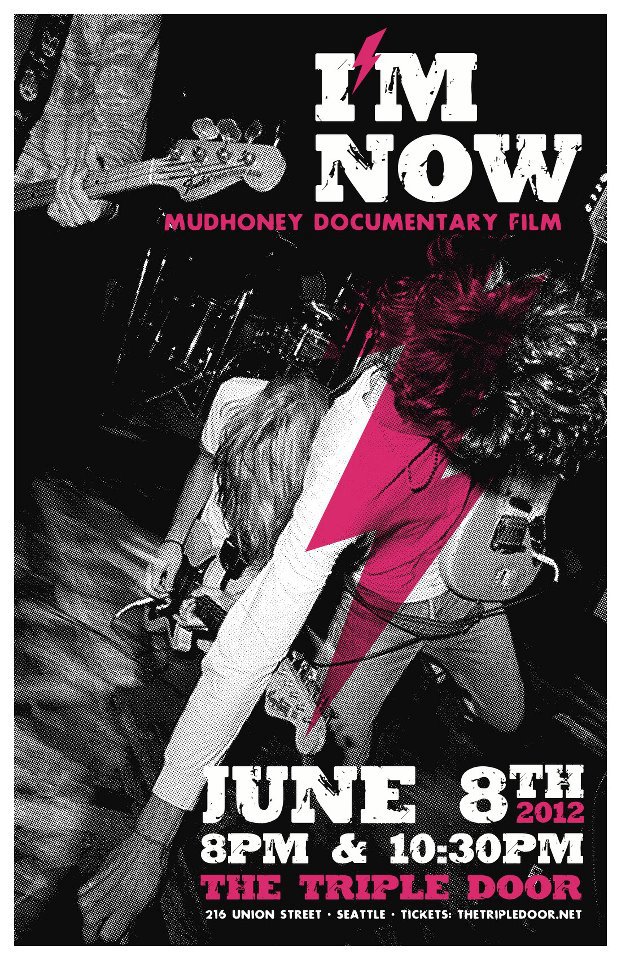
If you live in Seattle, you might be able to score a ticket to the June 8th premiere of “I’m Now”, the feature-length documentary which spans Mudhoney’s entire history and finally gives credit where credit is due. The Triple Door will hold two screenings of the film that night. It’s a beautiful theater and a great place to see this unforgettable film (review follows).

“I’m Now” (2012)
Directors: Ryan Short & Adam Pease
5/5 Stars

If you aren’t a Mudhoney fan when you start watching King of Hearts Productions’ new music doc, “I’m Now”, you certainly will be by the closing credits. The band has a lot to be bitter about. But they aren’t bitter. In fact, they couldn’t be more gracious. These are guys who love to play music and consistently found a way to keep doing it.

Interspersed throughout the narrative are interviews with other Seattle music scene notables including Bruce Pavitt and Jonathan Poneman of Sub Pop Records, Stone Gossard and Jeff Ament from Pearl Jam and Kim Thayil from Soundgarden. But none of these famous faces are as captivating as the band members themselves.

Each of the guys is interviewed separately, getting the chance to tell the story from their individual perspectives. They’re well spoken and clever, and never do they seem at all arrogant or inaccessible.

For me, one of the most refreshing moments is when front man, Mark Arm, speaks candidly about his drug and alcohol issues. He acknowledges the rock n’ roll cliché in which he found himself. But he didn’t have to surrender to any higher power to get through it. It’s not a juicy, “Behind the Music” tale. He just isolated the problem and took care of it. Fuckin’ A.

But it’s not just the interviews that enchant. It’s also the live performances. The footage from these shows is intimate and electrifying. Much of the b-roll is from the band’s own archives, but filmmakers, Ryan Short and Adam Pease, also followed Mudhoney on a recent tour. In 2008, this documentary team cut their teeth on a film about another unsung Seattle band, Tad (“Busted Circuits and Ringing Ears”). With a long resume of music videos, they certainly know how to film a band. As a result, “I’m Now” is the most riveting and reverent music documentary since Julian Temple’s “The Future is Unwritten”. Short and Pease have made an explosive piece of art, fueled by the raw power of Mudhoney’s music, that delivers sweet comeuppance to all the folks who did the band wrong over the years. Treat yourself to the aural and visual intoxication of “I’m Now”. I promise you won’t have any regrets come morning.

Film Threat Review: Mansome

2012
Unrated
84 minutes

*

Morgan Spurlock has quite a few talented names in his address book. Good thing too, because without them to pad his latest vanity project, he might be exposed for the hack he’s starting to become. If anyone is going to like a documentary about facial hair, it’s me. I’m what you might call a beardthusiast. But Spurlock’s “Mansome” fails to expose any sort of substance behind the follicles.

Maybe it’s because there isn’t actually much to talk about. Some people like beards and some don’t. Some men can grow a beard and some can’t. There are many different ways a man can sculpt his facial hair. Some people embrace their hairiness and some people seek to debilitate their entire bodies. And sometimes someone who can grow a very long beard will end up with delusions of grandeur. That’s about all “Mansome” has to say on the subject. The only real insight it gives is into the waning career of a once celebrated documentarian.

The aforementioned famous names include producer/director Judd Apatow, congenial actor Paul Rudd, professional attractive person and Old Spice spokesman Isaiah Mustafa and manthority Adam Corolla. The ubiquitous Scott Ian, who is apparently an authority on every single aspect of pop culture, can barely mask his ambivalence about the subject. He clearly has not given his ever-present goatee nearly as much thought as Spurlock has his own self-professed “signature” handlebar mustache.

Spurlock just can’t help but make at least part of the film about himself. He decides to participate in a “Reverse Movember,” with the pledge to shave at the conclusion of Lance Armstrong’s mustache-themed national fundraiser. I couldn’t have been less entertained watching Spurlock transform his face from that of a hipster douchebag into that of a regular douchebag. Though it may have been worth it to hear his young son (who had yet to see his father clean-shaven) wail, “You don’t look any good.”

Zach Galifianakis and John Waters also appear to discuss their own iconic facial hair. Their vignettes serve as the shiny, warm center to an otherwise ice-cold piece of poo. Waters is gracious and charming as ever. While Galfianakis gets in some great lines, he carries the look of a man who would rather be elsewhere.

The film spends a woeful amount of screen time with a less humble lot, including a professional wrestler who shaves his entire body, a self-professed “Metrosexual” and “Worldclass Beardsman” Jack Passion, who erroneously insists that his trophies make him something other than a huge waste of conditioner and oxygen. About the only thing Spurlock does right in “Mansome” is to juxtapose Passion’s scenes with sound bites from Judd Apatow, Paul Rudd and John Waters asserting that a man would have to be a complete dillhole to create a “career” out of having a beard.

And just when you think the inanity has reached its peak, Spurlock introduces us to the creator of a product called “Fresh Balls,” the purpose of which is self-explanatory. If this were a Tim and Eric sketch, the concept might be worth pursuing. Sadly, Fresh Balls is a real product about which the inventor is dead serious.

Executive producers Gob and Michael Bluth (Will Arnett and Jason Bateman), bulk up the film with footage from their trip to a day spa. The men wax poetic about male grooming while they are unpoetically waxed. Though their banter remains light, you can see that both of them are thinking, “I’ve made a huge mistake.” At best, “Mansome” is an A&E special to be DVR’d and deleted. Commercials would have been a welcome break. It’s quite a slog through the 84-minute running time.

Early in his career, Morgan Spurlock seemed like an important documentarian. In retrospect, the premise of “Super Size Me” is somewhat of a no-brainer. But it went deeper than the hypothesis that fast food is bad for us. It evolved into a meditation on food addiction. It got people talking and paved the way for real introspection on what we consume. Similarly, his docu-series “30 Days” seemed to strive for real change by letting the audience walk a mile in another person’s shoes. Since then, he’s reverted to his vapid beginnings as an MTV host, filling our eye holes with tripe. Here’s hoping Mr. Spur-schlock takes a long look in the mirror and gives that ego a shave.

Originally published on FilmThreat.com (now defunct).

Hotter with a Beard: Jarvis Cocker Edition

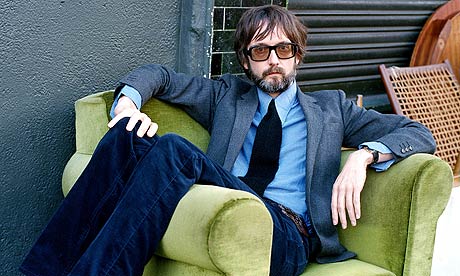
Now I know what you’re thinking. That voice! Those dance moves! The sharp-as-hell wardrobe! Jarvis Cocker is already an 11 on the 1-10 hotness scale. How could he possibly get any hotter? Well, feast your eyes on this:


Christ on a cracker! Hey Jarvis…Wanna turn that easy chair into a love seat?

If you need further proof, here he is throwing shapes at Coachella:

I’m pleased as punch to say I was there to witness it.

I’m sure you are convinced by now. But let’s see a few more pics for your Friday afternoon delight:

Could this be his O Face? Only a few lucky ladies in the world can say for sure:

Aaaaaand I’m spent. Time for a cold shower!

Film Threat Review: The Five-Year Engagement

2012
Rated R
124 minutes

**

I suppose that when a film is called “The Five Year Engagement,” one should expect a certain amount of foot-dragging in the narrative. Before we watched the film, my husband joked that he hoped it wasn’t shot in real time. It’s not. But, unfortunately, it often feels as though it is. Turns out, it’s not a lot of fun to watch a relationship fall apart even if you know that eventually, everything will turn out just fine.

We join the too-cute couple, Tom (Jason Segel) and Violet (Emily Blunt), on the night of the proposal. Despite pitfalls at every step of Tom’s elaborate engagement plan, Violet accepts. But, as the title suggests, their journey to matrimony is not without a lengthy series of unfortunate roadblocks. The first is the shotgun wedding of Violet’s sister Suzie (Alison Brie) and Tom’s best friend Alex (Chris Pratt). The unlikely couple hooks up at the engagement party and, with one pee stick, manages to take the wind out of Violet’s wedding planning sails.

Then, Violet’s master plan is thwarted when she receives a rejection letter from the Berkeley post-doc program. She decides she can re-apply in a year and really focus on the wedding, until she gets accepted into the University of Michigan. It’s amazing how quickly and easily she convinces herself that this is a viable alternative. Despite Tom’s burgeoning career as a chef in San Francisco, and their general happiness in the city with their friends and family, moving to Ann Arbor suddenly becomes the be-all for Violet’s aspiring tenure track. She goes through the motions of talking it over with him, but it’s clear she’s already made up her mind.

Tom and Violet had only been together a year when they got engaged, so they never had much of a chance to get used to melding their lives together. Instead of coming up with a mutually beneficial solution, Tom concedes to Violet, cocooning his resentment and disappointment so that it may emerge in the third act, a fully formed Mothra of relationship devastation. This isn’t unrealistic. On the contrary, it’s a little too on the nose. Apart from a few jokes about penis shrinkage, it’s mostly Dramarama for these two.

Rest assured, there is more to the film than cantankerous couple voyeurism. Jason Segel and his “Muppets” writing partner, Nick Stoller, also mix in plenty of saccharine sincerity alongside the cringingly realistic arguments that a couple has when one half has put their own dreams on hold for the sake of the other.

There are also all the drunken shenanigans, dick jokes and random violence that we have come to expect from the Apatow brand. The supporting cast does all the comedic heavy lifting. It’s so polarized that I often wished the film were ONLY about Tom and Violet’s friends and family. Just as Suzie and Alex steal the show from Tom and Violet with their shotgun wedding, Brie and Pratt steal the movie from Segel and Blunt. In both cases, the theft is inadvertent, but the superiority of the pairing cannot be denied. I’m convinced that Alison Brie is some kind of acting superhero what with her ability to nail any acting feat, including a passable British accent. Meanwhile, Chris Pratt plays a slightly more perceptive version of his “Parks and Rec” counterpart, imbuing every line with equal parts hilarity and sincerity.

If they didn’t steal the show, someone else would have. Viable candidates include Lauren Weedman as Tom’s butch boss, Mindy Kaling as one of Violet’s classmates and Brian Posehn and Chris Parnell as Tom’s Michigan pals. Even Tim Heidecker, Kumail Nanjiani and Molly Shannon, whose combined screen time total that of Jason Segel’s bare bottom, are far more enthralling in their cameos than any of Segel or Blunt’s scenes together.

Additionally, I feel kind of bad for the state of Michigan. The characters shit on it in scene after scene. The narrative montages through the temperate seasons, stopping only in the wintery months. Nearly every establishing shot includes a gray pile of slushy snow. Winters there would be hard on a naturalized San Franciscan, but absolutely no one seems happy to live there. When Tom searches for a sous chef job, he is consistently laughed out of the restaurants for having left his job in the Bay Area. Even people who have embraced the local color (which apparently involves running shirtless through the streets in collegiate support, cross-bow hunting, unkempt facial hair and home-brewed mead) make frequent jabs at their home state, which I doubt is as dreary and backwoods as the screenwriters would have us believe.

But here’s the biggest problem with “The Five-Year Engagement”: When film moguls reach a certain level of fame, they become incontestable. Everything they touch is deemed gold, even if it is, in fact, a pig in turd lipstick. Given my love for “Freaks and Geeks,” I really hate to say it, but I’m afraid Judd Apatow has become one such Faux Midas. I’ve said it before and I’ll say it again. No comedy needs to be longer than 90 minutes. Period. Even “Bridesmaids”, an otherwise terrific film, had some noticeable fat to trim. But here, the excess is blindingly apparent. Let’s start with cutting all the cliché shots of the Golden Gate Bridge and streetcars, which open the film with the sole purpose of establishing location, when a single line would have sufficed. I lose track of how many times we flashback to the moment when Tom and Violet met, but anything more than once is too much.

Many jokes are driven into the ground so deep, they come out the other side. We get it. Everyone in the Apatowverse is a supernaturally talented improviser. Simply filling your film with talented people does not give you a license to just let them “do their thing” unfettered. Actors need fettering (especially actors who double as screenwriters). There is a reason why people take classes on how to write and make movies. It’s because there are rules. I’m not saying it’s never OK to break the rules. But you should have a comprehensive awareness as to why you’re doing it. For the record, just REALLY liking a scene is not a good enough reason.

There is also the sad fact that Jason Segel’s raunchy, lovesick puppy dog shtick is wearing thin. In fact, the entire Apatowverse is. Bawdy rom-coms are no longer a novelty hand. Unfortunately, it appears that these folks have no other cards. Perhaps it’s time to let someone else play.

Originally posted on FilmThreat.com (now defunct).
Cookbook Review: Quinoa Cuisine

Not to brag or anything, but I’ve been into quinoa since before it was cool. I grew up with a slightly hippie mom who forbade sugar cereals and soda and thought that carob was an acceptable alternative to chocolate. We also rarely had red meat. She provided proteins from fish, chicken and tofu and, of course, quinoa. I became a vegetarian when I was 14 and finally began to appreciate my mother’s health-conscious ways. Because of her, I already had several healthy recipes under my belt. Of course, it never hurts to have more.

Quinoa has been very popular, of late. David Lynch even cooked up a bowl as a special feature on the “Inland Empire” DVD. And now we have Jessica Harlan and Kelley Sparwasser’s terrific cookbook, “Quinia Cuisine”, which boasts “150 Creative Recipes for Super-Nutritious, Amazingly Delicious Dishes”. If you’re skeptical about quinoa, that claim might sound like a bit of an oversell. Perhaps it’s because there are still a lot of people out there who are suspicious of it. I can understand why. It looks weird. It smells a little strange before you cook it and especially before you give it a good rinse. But trust me when I tell you that this strange little food really can be “amazingly delicious”.

“Quinoa Cuisine” is a terrifically laid out cookbook with an unusually worthwhile introduction, outlining its history and health benefits as well as many cooking methods and a few factoids. For instance, did you know that quinoa is NOT actually a grain? I did not. Apparently, it’s more closely related to beets, spinach and chard. What you’re actually eating is quinoa seeds, thus making it a “pseudograin”. I won’t spoil the whole thing for you. I’ll just say that I usually skim over introductions to pretty much every book I read. Not this time.

The actual recipes in the book are coded with helpful symbols that indicate such qualities as “30-minutes or less”, “gluten-free”, “kid friendly” and vegan or vegetarian.

The first chapter consists of “Essential Recipes” which are not only recipes you’ll make often, they also appear as part of other recipes later in the book. This is where you might begin to realize the true magic of quinoa. You can make every damn thing with it, from pancakes to pizza dough, tortillas to pie crust. If you’re living gluten free and didn’t know about quinoa this book will probably change your life.

From there, the book moves through every meal, blowing your mind with options: Breakfast, Starters, Salads, Soups & Stews, Side Dishes & Pilafs, Meat & Fish, Vegetarian and even Dessert. There are also special sections for Packed Lunches and Party Food. This is a truly comprehensive book that transcends genre and cuisine ethnicity. Think of your favorite dish. I’ll bet you cash money that there is some version of it in there. And, as a side bet, I wager that you’re going to love it made with quinoa. Maybe I have a little bit of a gambling problem. But that doesn’t mean I’m not right about this.

My one complaint with this book is that, apart from the front and back covers, there aren’t any photos of the food. I’m a visual person and I always like to compare my completed dish with the photo in the book, just to make sure I did it right. Granted, I get kind of annoyed with the step-by-step photos that food bloggers are so fond of. I don’t need to see what all my ingredients look like laid out on the counter together. But a little food porn is what often draws me to a recipe. I know they probably wanted to make more room for recipes (and possibly to save money by printing in black and white). But I wouldn’t mind a slightly higher cover price for the benefit of one little picture for each recipe.

Apart from the lack of photos, I am perfectly pleased with “Quinoa Cuisine” and highly recommend it to anyone who is already a fan or even a little quinoa curious.

  • Calendar

    • March 2026
      M T W T F S S
       1
      2345678
      9101112131415
      16171819202122
      23242526272829
      3031  
  • Search