
Hammer 2 Nail: The Reagan Show

113494976-0-768x512

“No wonder your president has to be an actor. He’s gotta look good on television!”-Doc Brown, Back to the Future

When asked if he thought his acting background was an advantage to doing the job of president, Ronald Reagan replied, “There are times I’ve wondered how you could do the job if you hadn’t been an actor”. It’s a telling statement from a president who spent two thirds of his time on public relations, logging more screen time up to that point than the combination of all other politicians since the advent of television. Sierra Pettengill (Town Hall) and Pacho Velez (Mankamana) created their documentary, The Reagan Show using news and behind-the-scenes footage from Reagan’s two-term presidency (1981-89). The result is equal parts amusing, upsetting, and apropos with regard to our current political poop show. Like with Trump, it was easy to make fun of Reagan when he didn’t have his finger on the nuke button.

The film has no narration, as none is needed. The footage speaks for itself. It’s a mostly chronological explanation as to why a man who was so ineffectual (if not downright detrimental) is considered by many to be “the Great Communicator”. No one can deny that he was charismatic. Like any actor, he knew how to smile, hit his mark, wave, and take direction. He was in his element at photo shoots, even coming up with a couple of ideas himself. POTUS was his meatiest role. But riding horses and inviting Mr. T to the Oval Office did nothing for the failing economy, the Cold War, or the threat of nuclear annihilation. As Ted Koppel so eloquently put it, “He’s a leader…but to lead us where…and into what?”

Read the rest on Hammer to Nail!
Lost in America

lost-03
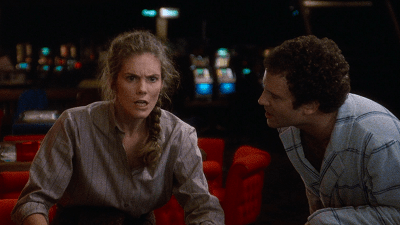
It’s been over 30 years since Albert Brooks unleashed his on-point satire about the mental unraveling of dissatisfied yuppies in Regan-era America. And while Easy Rider (1969) the film that inspires them, is even further in the rearview today than it was in 1985, the sentiments of ignorance, delusion, and privilege remain tragically relevant in what will one day be known as (barf) Trump-era America. Fortunately, because it’s an Albert Brooks film, these hard truths are wrapped up in a hilarious package, now available as part of the Criterion collection.

After being passed over for a promotion at his high-paying advertising job, David (Brooks) urges his wife, Linda (Julie Hagerty) to quit her job and sell everything they own to “drop out of society” and tour the county in a decked-out Winnebago. The key to making this plan work is his oft-referenced “nest egg” – the liquidated lump sum of their assets that is meant to keep them afloat for the remainder of their years on this planet. It shouldn’t be a problem because the idea is to simplify. After a grand send-off from their friends, they set out from Los Angeles, planning to renew their wedding vows in Vegas as their first stop. David and Linda will never be the characters from Easy Rider. But it takes them losing everything to truly understand that…

Read the rest at Film International!

Hammer to Nail: SIFF 2017 Wrap-Up

Better late than never!

The 2017 Seattle International Film Festival, which runs for 25 days every spring in the Emerald City, is four weeks of wall-to-wall, butt-numbing entertainment. This year’s festival took place May 18th to June 11th and featured 400 films from 80 countries. All told, there were 750 festival screenings and events, including 36 world premieres. That’s a lot of time spent in a dark theater. On the festival’s final day, the SIFF employees who introduced the screenings asked the audience how many of them had seen over 100 SIFF films this year. I was shocked when a couple of people actually raised their hands. Those folks averaged 4 films per day. My itinerary wasn’t quite as impressive, but I did manage to squeeze in 26 films, at an average of 1 per day. Hey, I had to see my kids some time.

siff2017-banner-1

Special honored guests included Angelica Houston, who received an award for Outstanding Achievement in Acting; and the buttery-voiced cowboy Sam Elliott, who spent an afternoon reminiscing about his career and taking questions from an enthusiastic audience.

There were a lot of great films this year.

Read about them on Hammer to Nail!

H2N Review: Beatriz at Dinner

1bea

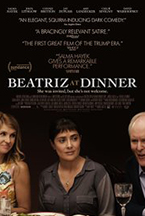
Donald Trump isn’t the first appalling billionaire, and he certainly won’t be the last. But what would you do if you found yourself at a dinner party honoring a man who has an awful lot in common with the hotel mogul (and some other title I can’t think of right now)? In Beatriz at Dinner, Mike White and Miguel Arteta’s latest collaboration, Beatriz (Selma Hayek) finds herself in this very position. She elects to not keep her worldview under wraps when faced with a man who is the very antithesis of all she holds dear.

Following in the footsteps of Jennifer Aniston in The Good Girl, Selma Hayek de-glams herself for the two Mikes in order to embody the character of a simple, earthy, Mexican immigrant who wants nothing more than to do her part to heal the world. She wakes up fresh-faced, empathetic eyes peering out from beneath woefully cropped bangs. She pulls on mom jeans and starts her day caring for the bevy of animals, including a goat, that she keeps as roommates. After a quick meditation session in front of an alter dedicated to family and a different goat, she loads her massage table into her relic of a Volkswagen, and heads off to a holistic cancer center where she pulls out all the naturopathic stops for struggling patients. This is the routine of a person who wants to help others, possibly at the expense of her own self-care…

Read the rest at Hammer to Nail!

This film was part of the 2017 Seattle International Film Festival.

H2N Review: The Fabulous Allan Carr

1carr

One of the greatest things a documentary can do is introduce a wide(r) audience to someone who contributed to the cultural zeitgeist without receiving proper recognition. Case in point: Allan Carr, a movie producer who brought us the musicals Grease, and La Cage Aux Falles and invented both the Village People and saying, “And the Oscar goes to…” instead of “And the winner is…” Maybe Grease didn’t influence your life per se. But I bet you know at least a couple of bars of “Summer Lovin’.” And even if you aren’t proud of that fact, chances are you’ll find something to love about The Fabulous Allan Carr.

Director Jeffrey Schwarz (I Am Divine) knows his way around a gay icon biopic. His latest film is based on the biography, “Party Animals: A Hollywood Tale of Sex, Drugs, and Rock n’ Roll Starring the Fabulous Allan Carr” by Robert Hofler. Schwarz didn’t have a lot of personal video archives to work with so he had to animate some of the story using a sort of art deco, “Bewitched” style. Sometimes animation can overwhelm a documentary, but since Carr was a larger-than-life persona, it works. Schwarz also collected a stellar group of people to discuss Allan’s legacy including close friend Lorna Luft, the singular Bruce Vilanch, and sound-bite master Frank DeCaro. Allan had a lot of friends. Really, almost every talking head in the film is identified as a friend of his. And they all loved him.

Read the rest of the review at Hammer to Nail!

This film played at the 2017 Seattle International Film Festival.

H2N Review: The Hippopotamus

1hippo

The opening of John Jenck’s The Hippopotamus is a flawless, wordless introduction to the film’s protagonist, Ted Wallace. It starts with a close-up of a book baring a snippet of the identically titled poem by T.S. Eliot: “The broad-backed hippopotamus rests on his belly in the mud; although he seems firm to us, he is merely flesh and blood”. While the original poem is a metaphorical takedown of the Catholic Church, Ted Wallace, a lapsed poet and current theater critic, is a man who is skirting the edge of oblivion with his lifestyle.

The camera pulls out from the poem to reveal an unmade bed covered in books, an overturned lamp, and a full ashtray. A hand tosses a porn magazine atop the pile of intellectual vice. The camera cuts to a nearly empty whiskey bottle set on a brimming bookshelf. The hand snatches away the whiskey bottle, revealing a photograph of Wallace with his son and a postage stamp over the face of one who can only be his ex-wife. He pours the whiskey into a glass. He unbuttons his shirt, exposing a large, round belly. The camera cuts to a wide shot, as Wallace lowers himself into a claw foot bathtub of steaming water. He immerses himself, comes back up spouting water, and then brings the whiskey glass to his lips as the title appears. We already know so much about this man without the utterance of a single line of dialog. Once Wallace starts speaking, however, he never stops…

Read the rest of the review at Hammer to Nail!

H2N Review: Infinity Baby

1infin

If you’re going to freeze your offspring at a certain age, the one in which they need the most care seems like the worst choice. But the eponymous company in Bob Byington’s Infinity Baby doesn’t make their money by selling babies that don’t age. Rather, they are a subsidiary of a pharmaceutical company who created these babies by accident and now must find homes for them. The pharmaceutical company most certainly makes money and lots of it. Those who choose to adopt an Infinity Baby are given a check for $20,000 and a supply of pills that nourish the baby once per day, keep it happy and sleepy, and somehow prevent it from soiling its diapers more than once per week. These kind souls are basically getting paid to help clean up corporate messes.

Read the rest of this review at Hammer to Nail!

This film played as part of the 2017 Seattle International Film Festival.

H2N Review: Handome Devil

1devil

Few things can make you feel more alone in this world than being surrounded by people whose priorities are completely at odds with your own. Ned (Fionn O’Shea) knows this pain all too well. He’s the only artistic fellow in a posh Irish all-boys boarding school where rugby is religion. If you aren’t part of the game, you’d best be cheering from the sidelines. And if you aren’t doing that, you’re in for a rough time. But when Ned gets stuck rooming with the new kid, a fetching rugby prodigy named Conor (Nicholas Galitzine), he finds kinship in an unexpected place.

Writer/director John Butler knows a thing or two about rugby fanatics. While the film isn’t autobiographical, per se, he did base the school in Handsome Devil on his own childhood alma mater. Ned is a suitable “every freak,” with a general interest in the arts, minus the talent to focus on any particular area. He gets good marks for writing, but only because he passes off song lyrics as his own. That all ends when a passionate and hip younger man (Andrew Scott, TV’s Sherlock) replaces the doddering old English teacher, and immediately spots the plagiarism.

Read the rest on Hammer to Nail!

Handsome Devil played at the 2017 Seattle International Film Festival.


H2N Reviews: Family Life; The Transfiguration; Score: A Film Music Documentary

Family Life (Vida de Familia)

Chilean directors Alicia Scherson and Cristian Jimenez teamed up for this tragicomedy about a trainwreck of a man who is ill-advisedly hired by his distant cousin to housesit for the family of 3 while they’re in Paris for several months. The script deftly hits on several beats including a satire of married life with a small child, the weird things people do when they’re alone in a house, and the trope of misunderstandings getting out of hand. Jorge Becker shines as the emotionally stunted house sitter who falls into a relationship with a single mother based on a fleeting ruse in this entertaining, dark, and occasionally poignant film.

Score: A Film Music Documentary

Matt Schrader wrote and directed this auditory treat about how music went from simply a distraction from the noise of a projector during silent film screenings to an indispensible part of the movies we love. You can’t think of Jaws, Psycho, or Star Wars without humming the score. Instrumental Gods like John Williams, Hanz Zimmer, and Danny Elfman discuss the nuances of their work and the process behind composing the most iconic music in film history. It’s lots of fun revisiting favorite emotional cinematic moments and also noting the vastly different outfits that score orchestra musicians choose to wear to work, from business suits to sweats.

The Transfiguration

Just when you think you’ve seen every possible take on vampires, Michael O’Shea presents a story that’s both genre subversion and a love letter to other subversive bloodsucker tales. Milo (Eric Ruffin) is a bullied teenage orphan living in the projects with his older brother. Whether or not his bloodlust is supernatural is left ambiguous, but he’s certainly studied. When he hangs with a similarly down-and-out neighbor girl, he ranks the realism of vampire iterations (his favorite being Let the Right One In). Dramatic irony meets urban allegory in a bleak but compelling story that will certainly resonate with fringe audiences.

These 3 films played at the 2017 San Francisco International Film Festival.

Reviews originally posted on Hammer to Nail


H2N Review: Half Life in Fukushima

1fuku

The title of Mark Olexa and Francesca Scalisi’s documentary, Half-Life in Fukushima, is a pun, of sorts. Half-life is the time it takes for the radioactivity of an isotope to decrease to half its original value. It is also an apt term for the life of Naoto Matsumura, a farmer who, along with his elderly father, continues to reside in the Japanese town that was evacuated after the 2011 nuclear plant meltdown caused by the one-two punch of an earthquake and a tsunami. At a mercifully short sixty minutes, Half-Life follows Naoto through his day tending to his farm and caring for his father. His down-time resembles every “last man on earth” style apocalypse film, as he hits golf balls on an empty course, sings a mournful karaoke tune to no one, and chain smokes while watching the news. He lives this way because he knows no other way. There is nothing for him outside the city. He can’t abandon his home, even though everyone else has done just that.

Though Naoto passes the occasional clean-up crew, he leads a nearly solitary existence. Occasionally, the filmmakers layer in sounds of the bustling city over shots of the man walking down the middle of a deserted street. At one point, the ambient noise changes as Naoto wades into the ocean. This time, instead of a thriving cityscape, we hear the screams of terror coming from people who have been told that they must leave or die. It is the reason they have not returned. Naoto is not dead, though he is not exactly alive either…

Read the rest at Hammer to Nail!