
Film Threat Review: Warm Bodies

2013
Rated PG-13
97 minutes

**

Let’s face it: Zombies are wearing out their welcome. I’ve been a fan of the genre since childhood, but of late, I’ve needed more than just the presence of the shuffling, flesh-munching undead to enjoy a story. It also has to have a plot and meaningful dialog. The characters need to do things that make sense within the confines of their established universe. It needs to do something different.

I started watching “Warm Bodies” with a modicum of optimism. Nicholas Hoult (“About a Boy,” “Skins” [UK]), who plays the lovelorn undead poster boy, is a versatile young actor. The premise is intriguing and moderately original (aside from the human/monster star-crossed lovers aspect). But they didn’t execute it well. It wouldn’t have taken all that much. Just a few tweaks here and there. Maybe give the human characters some personality so they’re distinguishable from the zombies in ways apart from their melanin levels. An overhaul of the ending (and the foreshadowing thereof) wouldn’t hurt either, as its saccharine triteness cheapens the good stuff that came before it.

The film, written and directed by Jonathan Levine (“The Wackness,” “50/50”), comes from Isaac Marion’s popular YA novel. The opening scenes hint at a depth of character and narrative insight that, sadly, dissipates once the love story kicks in. Hoult plays R, a hoodied hipster zombie who spends his down time shuffling around his airport dwelling with other lost souls. His ennui-filled voice-over introduces the audience to the particulars of this post-apocalyptic universe as well as his struggles to find a meaningful place in it. He laments the amnesia that has pushed him into an existential crisis of sorts (“Who am I?…Why can’t I connect with people?”).

Though his thought process remains in tact, his speech function is reduced to groans and the occasional word, phrase or clause. I love the idea of an Emo kid trapped inside the body of an instinct-driven predator. But the story betrays its own originality by eventually succumbing to romantic tropes. Every step it takes toward that end pulls it further away from the seed of brilliance from whence it came.

R isn’t completely unique amongst his peers. He has found a kindred spirit in M (played by an outstanding Rob Corddry). The pals groan at one another over empty cocktail glasses at the airport bar. Occasionally, they organize field trips into the city in the hopes of bumping into humans who have dared to venture beyond their steel walls in search of supplies.

R’s heart literally skips when he first sees Julie (Teresa Palmer), their eyes locking across a crowded bloodbath. After chowing down on her boyfriend and pocketing the leftover brains, he is compelled not only to spare her life, but also to convince her to come back to his place under the guise of protection. She goes without protest partly because she’s stunned by his mercy but probably also because, even for a dead guy, he’s pretty easy on the eyes.

After a couple of days spent listening to records (“Better…ssssound”, he grunts pretentiously) and trying on sunglasses, R starts to change. This is partly due to the absorption of memories and emotions (but just the romantic ones and in chronological order) that occurs when a zombie consumes a human brain. R’s warm and fuzzy feelings for Julie are amplified by his secret snacking on boyfriend leftovers. But his increased speech abilities and sudden repossession of physical senses have more to do with burgeoning forbidden love than zombie superpowers. Not only is it shoddy writing to default to the notion that love conquers all, even death. It also devalues R’s remarkable conscientiousness as a morally conflicted zombie. Julie can’t love R until he changes who and what he is. What an affirmative message for young people!

The strained zombie dialog that increases in verbosity as the film wears on also feels a lot like cheating. This story could have been so much more emotionally resonant if the actors had to…I don’t know…act to convey their thoughts. (See the “Buffy the Vampire Slayer” episode, “Hush” for an example on how to further a plot without dialog. In it, none of the characters could speak.) There are so many instances in which R could have used gestures, props (his airplane hipster pad is full of them) and facial expressions to communicate. I’m sure they still have Charades in the not-too-distant alternate future. Worse yet, much of what he says is exposition and often redundant. At least he never mentions anything about a Dark Passenger.

Contradictions and contrivances abound. Characters have instantaneous changes of heart, including M who takes about 5 seconds between scream-arguing that Julie is food to accepting her as part of the gang. R makes a joke about zombies being slow and then a couple of scenes later he and Julie must outrun them. Julie never seems all that broken up about the death of her boyfriend even after she learns that R was behind it. I guess they should get props for not using the “that was before I knew the real you!” plot device. But it still seems pretty convenient. Julie’s father, General “Pinot” Grigio (John Malkovich) is a narrow-minded, overprotective hardass. Yet, he doesn’t think twice about sending his only child into Zombieland on a “Pharmasalvage” mission. R is generally unwieldy but his motor skills are fine-tuned when the situation calls for it.

The situation calls for it during the war against the Bonies, a common enemy of both human and zombie. Bonies are zombies who have eaten their own flesh, thus stripping themselves of all humanity. Cool concept, right? Too bad they borrowed their skeleton effects from “Army of Darkness.”

It makes for an interesting story when the characters face seemingly insurmountable obstacles. You can still have a happy ending when those obstacles still exist but the characters have figured out a way to deal with them. “Warm Bodies” could have been the anti-“Twilight.” Instead, it’s just reanimated tripe.

Originally published on FilmThreat.com (now defunct).

Film Threat Review: Gangster Squad

2013
Rated R
113 minutes

***

From the opening scene of “Gangster Squad,” it became abundantly clear to me that I was watching a comic book movie. Though the film is based on a book (without pictures) about the 1949 real-life take-down of Los Angeles mob boss Mickey Cohen, there is very little realism in it. Maybe it’s Sean Penn’s prosthetically villainous face or his over-the-top punishments for double crossers. Such things are not often seen outside of a Garth Ennis graphic novel. Had Director Ruben Fleischer (“Zombieland”) gone for straight drama, “Gangster Squad” would have been a disaster. Fortunately, everyone involved was on the same page and that page is as colorful as they come.

“Gangster Squad” takes place in a post-war Los Angeles, where boxer-turned-mob boss, Mickey Cohen is on the verge of running the whole goddamn town. Since Cohen has already bought off most of the LAPD, Chief of Police, “Whiskey” Bill Parker (Nick Nolte) enlists chaotic good Sgt. John O’Mara (Josh Brolin) to put together a clandestine squad of like-minded cops. A Gangster Squad, if you will.

With the help of his reluctant, but resigned, wife, O’Mara assembles his A-Team: Jerry (Ryan Gosling), a fellow war vet, is the Face. Harris (Anthony Mackie) is the snarky loose cannon. Keeler (Giovanni Ribisi) is the wireman. He also throws in a couple of Young Guns for good measure in the form of a Wild West holdover (Robert Patrick) and is his rookie sidekick (Michael Peña). As the leader, O’Mara embodies the eloquence and fashion sense of Dick Tracy combined with the single-minded brutality and PTSD of the Punisher. His post-war life isn’t filled with tragedy, but you wouldn’t know it by the way he throws himself into fighting bad guys. His pregnant wife doesn’t like it, but she seems to understand that she married a full-time hero, even as she’s asking him to stay out of trouble.

Meanwhile, Jerry can’t help but court trouble in the form of Gracie (Emma Stone), Cohen’s reluctant lady friend. Their attraction is instantaneous and insurmountable. Their affair might seem like a frivolous risk, but have you seen Ryan Gosling and Emma Stone? You’d be crazy not to jump into bed with either one of them. Besides, the two actors have such chemistry that they inject their tryst with an air of genuine emotion.

The film’s biggest misstep was casting Sean Penn in a role that clearly should have gone to outrageous villain master Gary Oldman. There isn’t a moment he’s on screen that I’m not keenly aware that I’m watching Sean Penn. Everyone is wearing a costume, but Penn is the only one who seems like he’s playing dress-up.

But even Penn pulls off some pretty cool lines. In general, the repartee is as stylized as can be. Nearly every word uttered by a character is a period colloquialism or a one-liner. But that’s what you expect from a world with a fedora on every head, a smoke in every mouth and a flask in every pocket.

The Gangster Squad takes the best-dressed award; managing to look sharp no matter how much trouble they’re in. These men wear the uniform of the 40s Supercop. That’s because they are superheroes. There is a hailstorm of bullets every five minutes, but they always manage to stay dry. They survive an extremely reckless old timey car chase and even a couple of explosions.

In light of recent tragedies, there has been a lot of talk about gun violence in entertainment. “Gangster Squad” may experience a backlash despite deleting a shoot-out scene in a movie theater. There was heavy security at our screening, and they clearly weren’t looking for cell phones. But if you’re the sort of person who can’t tell the difference between real life violence and a cops-and-robbers fantasy world, you shouldn’t be watching anything but documentaries. The Los Angeles of “Gangster Squad” looks absolutely nothing like any city in modern, mass-murderous times. Sometimes, the best way to deal with crippling tragedy is to sublimate it into something fun. It’s meant to be a little shocking, in a cartoonish sort of way. The title alone is a tip-off. Nobody here is deluding themselves about what sort of film they’re in. Sometimes, even stellar actors want to take a break from the emotionally draining Oscar bait and make a bit of fluff. Why let Jason Statham have all the fun?

Originally published on FilmThreat.com (now defunct).
Film Threat’s Top Movies of 2012 List

Each of Film Threat’s writers made their own picks for their favorite movies of 2012. Here is my list:

I had a hard time getting to the movies this year. I feel like I saw more bad films than good, though that is probably par for the course. There are several films that might have made the list, only I haven’t seen them. Among them are Moonrise Kingdom, Argo, The Hobbit: An Unexpected Journey, This Is 40, and Seven Psychopaths. Of the films I did manage to catch, these are the ones I liked best:

1. The Cabin in the Woods
Number one with a “hacked off and ett” zombie arm. It’s not often that such a perfect send-up of a genre also serves as a masterful example of that genre.

2. I’m Now – The Story of Mudhoney
If you aren’t a Mudhoney fan when you start watching, you certainly will be by the closing credits. The band has a lot to be bitter about. But they aren’t bitter. In fact, they couldn’t be more gracious. These are guys who love to play music and consistently found a way to keep doing it. Ryan Short and Adam Pease have made an explosive piece of art, fueled by the raw power of Mudhoney’s music that delivers sweet comeuppance to all the folks who did the band wrong over the years.
3. Take This Waltz
Sarah Polley is a brilliantly nuanced filmmaker, mastering the art of “show, don’t tell”. She has the directorial eye of a painter, letting each shot speak volumes about her characters. Michelle Williams and Seth Rogen play no small part in weaving such a complex and morally ambiguous story about the beginning and end of love.
4. Safety Not Guaranteed
This adorable sci-fi offering to the Mumblecore genre re-defines time travel and showcases the dramatic chops of Aubrey Plaza (“Parks and Recreation”) and Mark Duplass (every Mumblecore movie) whilst preserving their comedic charms. It’s rare that a film about time travel will be so enchanting that you don’t even begin to analyze the time-space continuity until long after it’s over.
5. Lincoln
Daniel Day Lewis plays the shit out of one of the most important U.S. presidents in the history of U.S. Presidents. Emanca-motherfucking-pator of the slaves.
6. Tim and Eric’s Billion Dollar Movie
It’s not for everyone. In fact, it’s not for most everyone. But if you’re a fan of Tim Heidecker & Eric Wareheim’s surrealistic shock humor, you’ll probably laugh a lot while watching this film.
7. Grassroots
It’s amusing that one of the greatest political films I’ve ever seen is about something as seemingly insignificant as the 2001 Seattle City Council race. Stephen Gyllenhaal’s clever script is about more than just local government. In a presidential election year, it was inspiring to watch the “mostly true” dramatization of an unemployed alt weekly journalist who decides to take local politics into his own hands despite tremendous odds and a pessimistic political climate. Between “Grassroots” and “Lincoln”, I’m just swelling with democratic pride this year.
8. Looper
Another time travel goodie starring a digitally de-handsomed Joseph Gordon-Levitt, playing a young Bruce Willis who is hired to kill his future self. Even though they eventually do get into it, writer/director Rian Johnson gets major points for making Bruce Willis utter the line, “I don’t want to talk about time travel because if we start talking about it then we’re going to be here all day talking about it, making diagrams with straws”.
9. Old Goats
A well-told micro-budget story of a group of old men who are having trouble getting into the swing of retired life. It serves as a good reminder that even though it’s not over till it’s over, it’s never too early to start mulling over what you want to have done with your life.
10. Phantom of the Paradise
It’s probably not fair to include a film that came out in 1974 when there were other great films that came out in 2012. But it’s because of a mediocre 2012 film that I discovered this old gem, which immediately shot straight to my top 20 films of all time. “Paul Williams, Still Alive” profiles the titular prolific genius songwriter responsible for the songs of “Phantom” as well as a significant amount of musical masterpieces, including “The Rainbow Connection” and “Rainy Days and Mondays”. Williams also played a lead part in this stylized horror re-telling of “The Phantom of the Opera.” Nicolas Cage cites it as the film that made him want to be an actor. 30 seconds into the opening credits, you understand why that is. Brian de Palma was never as irreverent and groundbreaking and Paul Williams was instrumental in that mindblowing result.

Honorable Mentions:

The Comedy
There are very few people I would actually recommend this film too, but it gave me plenty to mull over and Tim Heidecker gives a beautifully understated dramatic performance about a trust fund asshole who is trying to deal with his father’s impending death.

Killer Joe
Juno Temple may be British, but I still consider her an American national treasure. I’ve never seen her do anything less than nail every single role. Here, she plays an underestimated trailer-dwelling teenage girl.

Liberal Arts
Josh Radnor (“How I Met Your Mother”) wrote, directed and stars in this excellent film, which could be considered a companion piece to “Old Goats.” Turns out there are a lot of parallels between the crises of 30-somethings and 60-somethings. Furthermore, Elizabeth Olson somehow manages to play a manic pixie dream girl without being annoying about it.

Wonder Women! The Untold History of American Superheroines
Great documentary about the woeful lack of female superheroes in popular media and the impact that has female genre fans.

Read the other lists at Film Threat.

Film Threat Review: Promised Land

2012
Rated R
110 minutes

**

Remember back in the late nineteen hundred and nineties when two handsome boys from Bahston arrived on the scene and wowed everyone with an original screenplay about a socially challenged blue-collar genius also from Bahston? And then afterward, everyone debated which of the two handsome Bahstonites was the most talented? And remember how, for a long time, all signs pointed to it being the blond one?

These days, I’m starting to believe we had it all wrong. Ben Affleck is still not a great actor, but somewhere along the way he became a good one. He also became a great writer and director, while Matt Damon plateaued. Now it seems that Damon is on a gently sloping downward trajectory; first with the treacle-laden “We Bought a Zoo” and now the face-slap of a morality tale that is “Promised Land.”

Now before you go accusing me of having no heart, I should tell you that I love both Matt Damon (usually) and the environment. Furthermore, I hate greedy capitalist behemoths that want to exploit simple farm folk and rape the land (grrrr). But that doesn’t mean I have to like a mediocre film about a greedy capitalist behemoth that wants to exploit simple farm folk and rape the land. “Promised Land” is an insulting delivery system for what would otherwise be a very valuable social message about the dying American Heartland.

The credits read like fantasy indie film draft picks: Directed by Gus Van Sant. Screenplay by Matt Damon and John Krasinski based on a story by Dave Eggers. Starring Damon, Krasinski and Frances McDormand with Rosemarie Dewitt thrown in just cuz a man can’t have true redemption unless a beautiful woman decides to love him. Damon plays career spin-doctor Steve Butler, a salesman for Global Crosspower Solutions (a name as ominous as it is vague). Global (Mr. Crosspower Solutions was its father’s name) seeks to buy drilling rights for America’s farmland in order to access the lucrative natural gas that lies beneath. Steve would be (and is) the first to tell you that he’s not a bad guy. He’s just a simple farm boy himself, hailing from a small Iowa town financially ruined after their primary industry (a Caterpillar plant) went under. He wants to make sure that doesn’t happen to any other small towns. He wants so badly to help, that he’s willing to sink to incredible depths of self-delusion in order to justify his job (emphasis on the word “incredible”). For a slick corporate shill, he’s more a rube than the local yokels he’s trying to swindle.

And that’s the point. In case you missed it (which you couldn’t possibly), Steve has been buying his own bullshit for too long. So much so that he completely crumbles whenever anyone challenges him. The writers borrow liberally from the plot of “Doc Hollywood” to deliver their messages about the dangers of corporate greed in general and fracking in particular. They assert that these are gray area issues, whilst drenching everything in black and white.

Presumably, Steve has brought his show to small towns all across the country. Yet somehow, the town of McKinley, PA is the first one to give him any trouble. His method of looking and talking like one of them is normally foolproof. But once a grizzled old science teacher (Hal Holbrook) calls him out on the dangers of fracking, Steve, along with his cynical partner, Sue (McDormand) must embark on a door-to-door campaign to win the town’s people back before the issue is put to a vote. An environmental activist named Dustin (Krasinski) poses additional challenges as he both literally and figuratively cock blocks Steve’s efforts.

It’s not all bad news. A talented cast acts its way around the ham-handed script. Krasinski is so believable in his role that it’s tempting to shout, “No! I don’t have a minute for the environment” at him whenever he’s on screen. McDormand uses her extremely expressive face to add complexity to her hard-nosed business lady character. Sadly, Rosemary Dewitt couldn’t save her character from Blandville, as she didn’t have much to work with. As a sweet schoolteacher named Alice, her character is perfectly content playing a pawn in the pissing contest between Steve and Dustin. One gets the distinct impression that Alice really doesn’t care with whom she ends up and she never seems to have much of an opinion about anything.

Damon saves most of the meat for his own character. He’s not too shabby playing a man who resists having his bubble burst even as the pin is puncturing the surface. That’s one thing they got right. People don’t usually have life-changing revelations over night. It takes time and lots of people telling you that you’re wrong before you start to believe it. Some will even take their skewed world views to their graves. Of course, we know that won’t happen here.

As a Commie liberal, it pains me to find so much fault with “Promised Land.” Those boys have a lot of good ideas and I know they mean well. Perhaps they’ve seen too many Hollywood Schmaltzfests to understand how to get their point across subtly. Furthermore, they don’t seem to have ever met any actual women because they have no idea how to write them. If you see only one film this year by a handsome actor from Bahston, make it “Argo.”

Originally published on FilmThreat.com (now defunct).

Film Threat Review: LES MISÉRABLES (2012)

2012
PG-13
157 minutes

***

If you aren’t already a fan of the Broadway smash about the misérable population of 19th century France, the film adaptation is not likely to win you over. It’s not bad when judged within the realm of its contemporaries (e.g. anything Andrew Lloyd Weber put his name on). But the story is, as my husband put it, preposterous. There is no way director Tom Hooper (“The King’s Speech”) could have fixed it without pissing off devotees. Instead, he produced an extremely reverent version of an often-laughable epic.

Based on the 1862 novel by Victor Hugo, the musical was written in French in 1980 and then adapted by some English guys in 1985. Despite poor critical reception, it became one of the longest running Broadway musicals of all time. The plot of “Les Misérables” is pretty convoluted and will probably sound outrageous to the uninitiated. But here it is in an enormous nutshell:

Jean Valjean (Hugh Jackman) is a freshly paroled prisoner concluding a 19-year sentence for stealing a loaf of bread. A particularly unwavering officer, Javert (Russell Crowe), doesn’t believe in rehabilitation and makes re-incarcerating Valjean his life’s mission.

Eight years later, Valjean has broken parole and reinvented himself as the good-hearted Mayor of a small town. He feels responsible for the fate of single mother/forced prostitute Fantine (Anne Hathaway), and rescues her daughter, Cosette, from a pair of abusive, flamboyant innkeepers (Helena Bonham-Carter and Sacha Baron Cohen).

Later still, Valjean and Cosette (now played by the doe-eyed Amanda Seyfried) have settled in Paris, where a group of dreamy, floppy-haired students are planning an uprising against the tyrannical monarchy. One of these students, Marius (Eddie Redmayne), happens to spot Cosette across a crowded, poverty-stricken square, and the two fall madly in love without having spoken a single goddamned word to each other. Regardless of the silly love business, the second half of “Les Misérables” is where everything gets exciting, as the rebels sing politics and plan their attack. Meanwhile, Javert and Valjean play cat and mouse and Cosette’s unsavory former guardians conspicuously attempt to grift everyone within spitting distance.

Hooper made several audacious decisions in an effort to capture the energy of a live performance. Though Hooper’s sets are much more elaborate than a stage production, they still exude theatrical artifice. He also instructed his actors to sing live on set, in lieu of the standard, yet restrictive use of lip-syncing. His most striking choice was to film his soloists in extreme close-up, bringing his audience face-to-face with the actors. They occasionally break the fourth wall, defying not only convention but also those audience members who might have otherwise tuned out. It’s pretty hard to ignore Hugh Jackman when his tractor-beam eyes are pulling you straight into the abyss of his nostrils. Hooper’s methods are sometimes jarring, but because of their surreal nature, they help to sell the singing dialog as well as some of the more absurd plot points.

Hands down, the best part of “Les Misérables” is the singing. Sacre bleu! Here, Hooper went for veracity, having his actors shed real tears, their voices quivering and occasionally even screaming the lyrics. His choice stands in stark contrast against the typical pitch-perfect stage performance. It serves to emotionally elevate songs that might otherwise feel contrived. Anne Hathaway steals the show by a mile with her rendition of “I Dreamed a Dream” (the song that made Susan Boyle a household name). The adorable rebels are also fantastic and clearly know their way around a musical. A theater veteran, Hugh Jackman is competent with his songliloquies, but through no fault of his own, they do go on. And on… And on… Russell Crowe is capable enough, belting out the thoughts of a blindly moral asshole. Compared to the talent of his colleagues, however, he might as well be doing karaoke. Besides, no matter how well he performs in anything, I just hate Russell Crowe’s stupid face. This is an issue all my own.

Hooper gives his singers even more emotional resonance by uglying them up. The down-and-out French population is grotesque to the point of zombification, and the scenery so filthy, you can practically smell it through the celluloid. In extreme close-up, the normally flawless Hathaway is all blemishes and grime. During Valjean’s lean years, Hugh Jackman looks so homeless that you want to put a blanket around his shoulders and give him a mug of hot cocoa. Though they may be little more than Oscar ploys, they work.

The weakest link is Seyfried who didn’t get the memo about Hooper’s aesthetic. It’s not entirely her fault. Grown-up Cosette is bland as can be and nothing more than a pretty little plot device. Bonham-Carter and (as much as it pains me to say it) Baron Cohen also massively taint the scenery. I know this isn’t just me, because when Bonham-Carter first appeared on screen, looking like a (somehow) campier cross between Marla from “Fight Club” and Bellatrix Lestrange, the audience burst into giggles before she even opened her mouth. Baron Cohen goes balls out (not literally, in this case) with the physical comedy, channeling Peter Sellers in “The Pink Panther”. Clearly, these characters are intended for comic relief. But their shtick feels entirely out of place, as if they jammed a number from “Annie” right in the middle of this extremely melodramatic historical opera.

Regardless of its flaws, “Les Misérables” remains entertaining throughout its 157 minute run time. If you don’t usually enjoy musicals, this will be no exception, but devoted fans will surely yum it right up. If you dig musical theater at all, it’s worth a viewing just to see Anne Hathaway pwn what will undoubtedly be an award-winning role. “South Park” fans might also enjoy some of the revolutionary plot, if only to see where Trey Parker got his inspiration for “La Resistance”.

Originally published on FilmThreat.com (now defunct).

Film Threat Review: Lincoln

2012
PG-13
149 minutes

****

There was a time when politics were exciting and meaningful, rather than combative and depressing. We made up our own country, for shit’s sake! Granted, we did it on land that wasn’t ours…

Regardless, we rebelled against our oppressive motherland and started over from scratch. Since we didn’t want to fuck it up, we agreed on a list of rules. We created a system designed to give everyone a voice and an infrastructure of checks and balances to keep ourselves from regressing. We fought and died for the rights of those who wanted to be part of our union. But somehow, we lost touch with our goal. We became exclusive and we were pretty terrible to the people we didn’t want in our club. In a way, when the 13th amendment passed, it was a renewal of vows for the Constitution. It was a footnote that said, “You know all those rights and self-evident truths we were just talking about? They should apply to everyone.”

Steven Spielberg’s latest epic, “Lincoln,” is a beautiful portrait of one of this country’s greatest leaders during the most important part of his life. The film’s tone is optimistic whilst still acknowledging the faults of men. Somehow, it manages to add suspense to a tale we already know by heart. Best of all, it’s celebratory of our nation without being jingoistic. I wish we could have elected this movie as the next President of the United States of America.

Some would argue that not much has changed, hence the phrase, “Politics as usual.” But it’s not every day Congress ratifies an amendment, particularly one that ends a war that has split the country in two. Despite the all-encompassing title, “Lincoln” only covers the last four months of the 16th president’s career and life, which revolved around the resolution of the Civil War and the ratification of the 13th Amendment. But we don’t need to see the rest of his life to understand Abraham Lincoln’s true quality. Daniel Day Lewis fully embodies the prominent image. His Lincoln is soft-spoken, gentle and cunning.

He needs to pass his proposed amendment through Congress before the war ends because it will be much harder to do once the Confederacy is allowed to resume federal representation. Meanwhile, he receives pressure from all sides to end the war by any means necessary and “stop the bleeding,” even if it means putting off the vote. Since it is the very morality of the 13th amendment that is under contention, Lincoln uses his lawyer cunning to come up with “practical” reasons to abolish slavery. (I found this aspect of the film particularly amusing because I took history class in Virginia, where they did their best to sweep all that nasty racism under the rug. I can’t tell you how many times I had to answer the question, “Name two motivations for the Civil War other than slavery,” on a test.)

The film opens with a brutal combat scene in which men die under great anguish, but that is the only time we visit an active battleground. I prefer Spielberg when he deals with war from a distance. There have been enough films to show us what being in the shit is like. Here, we spend most of our time with the men who put them there, peppering the story with just enough carnage to remind us that people died over this heated debate between old white men.

I would be shocked if “Lincoln” didn’t dominate this year’s Academy Award nominations. Normally, I would hate a movie that the Academy will so clearly embrace. This film had every opportunity to be a giant schmaltz fest, and it took the high road at nearly every turn. Only a handful of times did I feel that I was being played for emotional response (watch yourself, John Williams). The rest of the time, my emotional responses were 100% genuine.

It didn’t hurt that many of the grand speeches given were the real words uttered by those most eloquent history-makers. The tight script by Tony Kushner (“Angels in America,” “Munich”), is based in part on the biography, “Team of Rivals: The Political Genius of Abraham Lincoln” by Doris Kearns Goodwin. As you might expect, they play all the hits. Sometimes famous speeches can sound hackneyed, but if you get the right person reciting, it will be as fresh and stirring as the day it was first uttered. Tommy Lee Jones, who plays the grizzled “radical Republican” with the biggest emotional investment in the amendment, seems poised to receive a standing ovation after nearly every scene. If “Lincoln” had been performed on stage, he probably would have.

That is not the only way in which “Lincoln” evokes the Bard. I’m sure the costumes are authentic, but those wigs, ruffled ascots, and extravagant facial hair seem, at times, a little over-the-top. There is also comedic buffoonery, as performed by three lobbyists (John Hawkes, Tim Blake Nelson and James Spader) Lincoln employs to secure votes from the opposing party; There is an overbearing wife (Sally Field), driven mad with grief; And, of course, there is a tragic hero. The events depicted are so significant, the characters so iconic, that it is impossible to get lost in the story without constantly being reminded that you are watching history.

Nonetheless, the film’s only real weak moments are when it deals with Lincoln’s private life. Lincoln’s oldest son, Robert (Joseph Gordon-Levitt), wants to enlist in the Union army despite his parents’ wishes. Abe and Mary fight over the correct way to be sad about the death of their middle child. Field delivers her lines with histrionic, movie-of-the-week fervor. These subplots feel superfluous, and perhaps they should. After all, it’s his political work that made Abraham Lincoln such a symbol of true American values.

Though you can, at times, see the seams around his eyes, Day-Lewis’ face is so accurately transformed that it may as well be a C.G. overlay of the actual president’s head. Day-Lewis plays Lincoln as a complex man who keeps his demons at bay for the good of the country. He is a raconteur who chooses his words carefully as if he knows that everything he utters will be recorded for posterity. And that’s in keeping with the spirit of the nation, because every decision that our government makes affects each of its citizens individually. He’s a hero who is just doing what he knows is the right thing to do. He’s an idol, but he’s also accessible because we all have the potential to be that heroic. In the words of the film, it’s a “democracy to aspire to.”

Originally published on FilmThreat.com (now defunct).

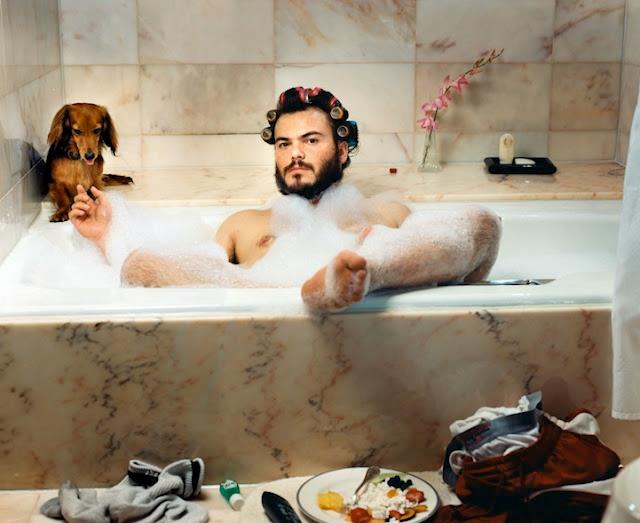
Hotter with a Beard: Jack Black Edition

I ganked this photo from my friend’s FB feed so I have no idea how recent it is. Regardless, I’ve had an on-again/off-again crush on J.B. since the High Fidelity days.

On again: Mr. Show/Tenacious D
Off again: Shallow Hal/Ice Age
On again: School of Rock
Off again: Nacho Libre
On again: Be Kind Rewind (even though that movie kinda sucked, both JB and Mos Def were adorable in it)/Pick of Destiny
Off again: Gulliver’s Travels/all that Kung Fu Panda business
On again: This photo…

Kinda makes a girl hope for some popping out of the side hatch with oils and perfume (and incense).

Tobe

I don’t so much write personal blog entries anymore, but I need to get this out. If you aren’t interested in the memoirs of a crazy cat lady, you’d be wise to do something else with your time.

Otherwise…

I’ve been very fortunate to have very little experience with death. I have had relatives die, but they’ve all been people I hadn’t seen, or, in some cases, even spoken to, in over a decade. I’ve comforted friends when they’ve lost loved ones. While I can certainly conceive of their pain and empathize, the closest I’ve come to first-hand grief is with pet death.

More often than not in my life, I’ve owned a pet of some sort. A human is, in all likelihood, going to outlive his or her pet. It’s something that everyone knows when they decide to adopt an animal. As we grow to love them as part of our family, we try not to think about it until it’s staring us in the face. When our pets get old, we expect their imminent death and try to make them comfortable toward the end. But sometimes, our pets don’t have a chance to get old*. As a jerk who has mostly eluded first-hand loss, it’s kind of a big deal.


Tobe a.k.a. Toblerone, Tobenstein, Captain Fluffypants, Falcor and, as recently dubbed by my daughter, Tobe Beeb.

I’ve had Tobe for 8 years. He was approximately 1 year old when I rescued him from the shelter. It feels silly to say “rescue” in Tobe’s case because he is such an awesome cat that he would not have been there long. More accurately, I snatched him up. Later on, I learned that he is, at least mostly, a type of purebred cat called a Ragdoll. They are large, fluffy things, designed to live in your lap. Tobe has zero hunting instincts. Once, I saw him watching a flock of birds in our yard, tail swishing all the while. I decided to let him out to see what he would do. He went bounding out of the door like a dopey puppy and the birds flew away instantly. I wish I’d gotten it on video because he’s never tried to stalk anything since.

Tobe is a mama’s boy. Before my daughter was born, he was a near-permanent fixture on my lap. The common scene for us was as it is right now. He’s draped across me as I type. Every once in a while, he gives me an appreciative nudge. Whenever I’ve been sad, just burying my face into his big, furry belly always made me feel better. Many people tell the same story. My relationship with my cat is not unique. Nonetheless, it feels special to me. I’ve always been a cat person. But Tobe is more than a cat to me. Tobe is my baby.

When I first got pregnant, Tobe knew something was up. He started getting grumpy and peeing inappropriately (i.e. all over my breakfast nook). After all the tests came back negative, the vet surmised that Tobe was depressed. He somehow knew that he was about to be put on the back burner and he was not happy about it. Fortunately, anti-depressants work on cats. That’s right. My cat has been on fluoxetine for 3 years. It’s a pain in the ass, but it’s a lot nicer than cleaning up pee every day.

As my daughter has required less attention, Tobe and I have been able to re-forge our relationship. That’s why I really noticed when he stopped hanging out with me. It went on for a couple of weeks. He’d been slowly losing weight over the past couple of years, but he had some extra love in the beginning. When he reached a healthy weight, I expected the loss to taper off. It didn’t. He got thinner and thinner, but all the tests came back negative. When he became reclusive, I knew there was definitely something wrong. The vet did some more tests including a “senior panel”. At 9 years old, it seemed early for that. But it succeeded in finding the cause of his weight loss. He had low protein levels indicative of an issue with his digestive system. I nodded throughout the vet’s speech, but I’d stopped listening after “low protein”. When she suggested I schedule an ultrasound, I laughed a little. Obviously, that was going to be pretty expensive. I said I’d think about it.

Tobe seemed to be complaining about his cat food. He’s always been on a dry food diet, and, though he can be choosy, at that moment, his bowl was filled with his preferred brand. He meowed at me in his way (which doesn’t sound much like a meow…more like a “meh”). He is almost always silent unless he really wants something. I realized that it had been at least 24 hours since I’d seen him eat. On a whim, I pulled out a can of wet food, and he actually got up on his back paws and meh’d at me again. I have never seen him do this before. I put the food in his bowl and he devoured it. I immediately bought more canned food. His appetite was back. He started hanging out with me again. “Great!”, I thought. “He’s getting better! He just needed more protein”.

Denial is a motherfucker.

The vet called me about a week later, concerned that I had not yet scheduled an ultrasound. Through the course of that conversation, I realized that the results of his senior panel were much worse than I thought. Whatever was causing his low protein levels was certainly deadly. There was a slim chance that it was something curable, like liver disease, but more likely, it was something much worse. The doctor explained that if we find out what it is, we can at least make him more comfortable. Still in shock, I made the appointment.

On the ultrasound, they found 1 mass on his colon and 1 on his small intestine. They did a non-invasive biopsy and the results came back today. Lymphoma.

My cat has fucking cancer.

Now, there are all kinds of expensive treatments I could administer that might prolong his life up to a year and would require monthly blood tests. There is also a minimal treatment that requires only another daily medication and would give him 3-6 months of comfortable existence. “Maybe longer,” she said. But I think that was for my benefit, as she could probably hear the sniffling through the phone. As much as I’d love to be the crazy cat lady spending all my savings to keep my baby around longer, I’m not going to do that. He would hate me for taking him to the vet once a month and he’s already not thrilled about taking a pill every single day of his life. Now I’m adding one more. With the “aggressive treatments”, it would be 2-3 more medications. All to put off the inevitable. I’m not doing it. Do I feel guilty about that? You bet your ass I do. But I also know it’s the right thing to do.

The next couple of months are going to be really fucking hard. I did not expect to have to explain death to my 2 1/2 year old. But she’s going to wonder why mama is constantly sobbing into Tobe’s fur. Eventually, she’ll ask where Tobe went. She probably won’t even remember him when she’s older. I had visions of her devastated at 5. That might still happen with our other cat, Lucy. She’s 16 goddamned years old. She went to the vet for the first time ever this year and she had NOTHING wrong with her. She’ll probably live to be 20. She’s the Mr. Burns of cats. I didn’t expect her to outlive Tobe. Very few things turn out the way you expect.

Death is a hard lesson for a 2 1/2 year old. It’s even harder to learn when you’re a full grown woman. I’m fortunate to have experienced very little tragedy up until now. I know I’ll move on and everything will be fine. I’ll eventually get a new cat. But Tobe is going to be a tough act to follow. He’s still here now, snuggling up to me as I type. I hope that I can cowgirl up and make the most of the rest of our time together. But right now, all I can think when I bury my face into his now emaciated (but still quite fluffy) belly, is “I’m really going to miss this goddamn cat”.


(Told you he was fluffy.)

Thanks for reading.

*When I linked to the Ragdoll Wikipedia page, a sentence stood out – “One study utilizing Swedish insurance data showed that of the common cat breeds, the Ragdoll and Siamese have the lowest survival rate, with 63% living to 10 years or more for the Ragdoll and 68% for the Siamese”. I’m sure that fact is prevalent in Ragdoll literature. Apparently, I’m awesome at glossing over unpleasantness. Though it is somewhat comforting to know that he is among the 63% of “long-lived” Ragdolls. Purebreeding is a motherfucker.

Film Threat Review: Keep the Lights On

2012
Unrated
101 minutes

****

Some long-term relationships seem perfectly stable until the end, when they suddenly aren’t anymore, and others are tumultuous from the get-go. Ira Sachs’ mostly autobiographical film, “Keep the Lights On,” chronicles the nine-year span of a gay New York-based documentary filmmaker and his challenging, but unwavering, commitment to a crack-addicted lawyer. The catharsis oozes off the screen in this unflinching, but affectionate, portrait of a man and his junkie.

Sachs’ proxy is Erik (Thure Lindhardt), a struggling Danish filmmaker. His passion project is a documentary about underground queer artist Avery Willard, who produced erotic queer images from the 1940s through the ‘70s. While he struggles through production, he whiles away his nights on a phone sex line, which often leads to casual encounters. (This is how they did it before Craigslist, kids.) One such encounter leads to love when he meets Paul (Zachary Booth).

At first, Paul tells him not to get his hopes up, because he has a girlfriend. But their attraction is undeniable, and soon the girlfriend is a non-issue. Early on, Paul introduces Erik to the joys of recreational crack. It’s not long before it becomes more than just a hobby for Paul.

Every so often, the narrative jumps forward in time, as Paul disappears on benders. If Erik isn’t busy doing filmmaker stuff, he makes time with prostitutes to help keep his mind off of his absent boyfriend. Through it all, Erik’s devotion to Paul is unwavering. There are interventions and ultimatums, splits and reunions, but the two always end up back together. It’s not exactly an abusive relationship – Erik can take care of himself. But his heart belongs to a man whose devotions are equally split between his boyfriend and crack pipe.

The film is shot on super 16, which lends the images simultaneous warmth and isolating frigidity, mirroring a relationship whose temperature is constantly in flux. Sachs does an excellent job establishing a time and place without the need for telltale skylines or period-specific props. Many of the scenes were shot in the exact same spots that the real-life version of events occurred. Even without this knowledge, the candor is unmistakable. These conversations and scenarios are too painful to be fiction.

At one point, Erik finds Paul on a bender in a filthy loft and refuses to leave without him. Erik holds Paul’s hand as the man he loves has cracked-out sex with a prostitute. He knows he can’t make Paul stop his destructive behavior, but he can’t bear to leave him to it. It’s a powerful scene that also serves as shorthand for their entire relationship. Even if they can’t be together the way Erik wants, he can’t let Paul fall all the way into the abyss. It’s more painful for him to let go than to stay with a man who refuses to stop hurting both of them. This is the stuff of 18th century poetry. It’s literally Romantic.

“Keep the Lights On” is heavy stuff indeed – the antithesis of “The Notebook.” It’s bona fide, messy, heart-wrenching pain. Sachs clearly went to a lot of trouble to tell this story, essentially emptying his soul into the film. The least you can do is listen.

Originally published on FilmThreat.com (now defunct).

Film Threat Review: Bachelorette

2012
Rated R
94 minutes

**

If bridal parties in real life behaved like the bridal parties in film, everyone would elope. “Bachelorette” will most certainly be compared to both “The Hangover” and “Bridesmaids,” but that comparison is not fair to those movies. Leslye Headland wrote and directed this adaptation of her off-Broadway play a year before “Bridesmaids” was released. Her story of the most unlikable group of women since “Sex and the City II” shares little with those far superior films besides a wedding-related misadventure.

The characters in “Bridesmaids” do and say some stupid things, but they are, at heart, good people. “The Hangover” crew isn’t so nice, but at least they are the butt of the joke. But the biggest difference between “Bachelorette” and its so-called peer films is that the other characters actually like the person who is getting married. The women of “Bachelorette” turn the story into one long, cruel fat girl joke punctuated by a “just kidding” ending.

In “Bachelorette” three emotionally arrested Mean Girls are asked to be bridesmaids by their token scapegoat, Becky (Rebel Wilson). In high school, they dubbed Becky “Pig Face,” and have thought about her in those terms ever since. According to the movies, weddings are the most significant event in every woman’s life. The troika are furious that not only is Becky walking down the aisle before them, her groom is one of the richest, most handsome men in New York City. It boggles their minds that Becky would be able to score a man who is essentially the prom king of the adult world.

In fact, much about the adult world confounds these women. If they each had their own derisive nickname, Katie (Isla Fisher) would be “Dense Face”; Gena (Lizzy Caplan) would be “Tramp Face” and let’s just give Regan (Kirsten Dunst), the group’s leader, the all-encompassing moniker, “Cunt Face.” I’m usually happy to see any of these actresses on screen. Dunst generally brings a lot of heart to her ice queen roles. Isla Fisher is a flawless comedienne, able to completely transform herself into whatever the script calls for. Lizzy Caplan has already proven that she can play a loveable fuckup. But Headland’s script is so lacking in depth, that they have nowhere to go besides what’s on the page.

Regan is the most wounded about the wedding, wondering why her hard-won beauty and success haven’t scored her a husband. She serves her Maid of Honor duties under cover, pretending to respect Becky to her face and ripping her apart when she is out of earshot. Katie has a vague idea that she “might be stupid,” but she doesn’t let that humble her, using people whenever possible and getting away with it because of her looks. Gena walks through much of the movie a complete sociopath, seeing those around her as little more than annoying little insects that sometimes prevent her from doing all the cocaine. She is closest thing “Bachelorette” has to a whole person, but that’s not saying much considering her most likeable quality is that she’s sad about her ex-boyfriend and the teenage abortion they shared.

Nonetheless, it is Gena’s storyline that provides the film’s one redeeming quality: Adam Scott. As usual, his affable-as-hell little face is like a golden turd in an overflowing cat box. I’m always happy to see him, even when the stench of a film is insufferable. (In fact, one of the two stars I gave this film belongs entirely to him.) Scott plays Clyde, the aforementioned ex, who also happens to be a groomsman in the wedding (just go with it). The only reason this pairing makes any sense is because Caplan and Scott have an established chemistry from their time together on “Party Down.”

That Becky would invite these terrible people, whom she hasn’t seen since her formative years, to play such a major part in her wedding, is baffling. But it is crucial to the plot. It is only by being bridesmaids that they have access to the wedding dress, which they accidentally destroy in a moment of insanely cruel drunken shenanigans. The troika spends the rest of the film running amok in New York under the guise of trying to fix or replace the dress. In the meantime, they do loads of drugs, visit a strip club, navigate male genitalia, take shots, insult people, do more drugs and then abruptly decide that they want to change their evil ways just in time to save the day they were responsible for almost ruining.

Headland seems to have been so busy thinking up “shocking” scenarios that she forgot to write any real jokes (unless you think an overdose is funny). It’s not the crudity of these women that offends. It’s their complete lack of integrity. I have plenty of time for characters with sexual confidence and profane bluntness but not so much for those who use their powers to demean everyone who crosses their path. Even then, I can enjoy a film about abhorrent people so long as they get their comeuppance, or end up alone with their misery (see “Very Bad Things” for an example on how to properly execute this maneuver). Instead, Headland expects her audience to accept her characters’ all-too-convenient third act changes of heart. I’d be shocked that Becky forgives them for nearly ruining her wedding, if she had any personality at all besides being completely comfortable with herself.

It doesn’t help that we are completely in the dark about Becky and Dale’s relationship. They rarely share a scene and she never really talks about him or he about her. It’s not that they are an unlikely couple. It’s that SO MUCH is made of Becky being a “fat loser” that it feels like it could turn into “Carrie” at any moment. Actually, a telekinetic wedding massacre would have improved this movie tremendously.

Originally published on FilmThreat.com (now defunct).